- What changed under Arizona’s new cannabis advertising law
- Which cannabis businesses and marketing partners may be affected
- What the law says about audiences, imagery, warnings and license information
- Which website, social media, email and offline assets should be reviewed
- What I would do now if I were responsible for an Arizona dispensary’s marketing
One of my long-term Arizona dispensary clients recently forwarded me information about the state’s new marijuana advertising law and asked what it meant for their marketing. Since we already manage marketing for cannabis businesses, I wanted to break down what Arizona dispensaries and marijuana companies actually need to know and which marketing assets should be reviewed right away.
The new rules take effect July 1, 2026. They can affect much more than paid ads. Websites, social media, email, SMS, videos, graphics, online menus, billboards, sponsorships and third-party listings may all need attention.
I am a digital marketer, not an attorney, and this article is not legal advice. I am sharing what we learned while reviewing the new requirements for a real Arizona dispensary client and translating them into practical marketing decisions. Your attorney should confirm how the law applies to your specific business and campaigns.
Why Is Arizona Tightening Cannabis Advertising Rules Now?
Arizona has said the purpose of HB 2179 is to keep marijuana advertising from targeting children. That is the stated reason, and many of the restrictions clearly focus on youth-oriented names, characters, imagery and placements.
I also think the law will have another practical effect: it will make it harder for cannabis companies and third-party advertisers to disguise what they are promoting.
Cannabis businesses generally cannot advertise marijuana products through Google Ads or Meta Ads. Still, I regularly see businesses trying to get around those restrictions by removing words like “cannabis,” “marijuana,” “dispensary” or “THC,” promoting a vague wellness offer or sending traffic to a landing page that does not immediately reveal what the company sells. Sometimes those ads get approved, at least temporarily.
Under the new Arizona rules, advertising hosted by a platform must clearly identify the licensed marijuana establishment or nonprofit medical marijuana dispensary responsible for the content by name and license or registration number. It must also include the required warning. That makes a deliberately vague cannabis campaign much harder to pass off as ordinary wellness advertising.
This feels familiar to me because I have watched the same pattern play out in addiction treatment marketing. Years ago, treatment centers and lead generators were getting away with aggressive tactics, misleading websites and questionable advertising. Eventually, Google required addiction treatment advertisers to obtain LegitScript certification before they could run ads. It did not eliminate every bad actor, but it added a verification layer and made it harder to hide who was actually behind the campaign.
Cannabis is different because the major platforms still largely prohibit the advertising itself, but the broader lesson is the same. When companies keep looking for loopholes, the rules tend to become more specific. Legitimate, licensed dispensaries may not love giving up valuable design space to warnings and license numbers, but transparency should ultimately make it harder for unlicensed sellers and disguised lead-generation sites to blend in.
Who Has to Follow the New Rules?
The law applies to licensed marijuana establishments, nonprofit medical marijuana dispensaries and businesses that sell marijuana paraphernalia. It also affects advertising platforms and third parties that create, host or distribute cannabis advertising.
That means a dispensary should not assume its media buyer, billboard company, influencer, graphic designer, website vendor or outside agency already understands the law. The client may be licensed, but the people building and publishing the campaign are the ones applying the requirements every day.
At a minimum, every marketing partner should receive the correct legal business name, license or registration number, approved warning language, age-targeting standards and clear rules for imagery and claims.
What Counts as Cannabis Advertising?
One of the easiest mistakes to make is assuming the law applies only to paid advertising. Arizona defines advertising broadly as a public communication in any medium that offers or solicits a commercial transaction involving marijuana or marijuana products.
That can include paid and organic social promotions, website banners, email and SMS offers, sponsored content, influencer posts, promotional videos, billboards, flyers, online menu promotions and third-party directory listings.
Not every mention of a dispensary is necessarily an advertisement. Educational content, general business information and communications targeted only to an established customer base may be treated differently. But if a piece of content is encouraging someone to buy a product, claim an offer or visit a dispensary, I would review it as advertising until counsel says otherwise.
Do not only review what is currently scheduled. Old Instagram posts, YouTube videos, website banners, automated emails and third-party listings can remain public for years. A compliance audit needs to include the marketing that is still accessible, not just the next campaign.
What Arizona Cannabis Advertising Cannot Do
1. Do Not Build Creative That Appeals to People Under 21
The law restricts marijuana advertising aimed at people under 21, including names that resemble food or beverage brands marketed to children, toys, cartoons, animated or fictional characters, consumption imagery, potency or THC levels and media with a special appeal to younger audiences. The statute even names Santa Claus as an example.
Most legitimate dispensaries are not intentionally marketing to children. The problem is that creative choices that feel normal in another industry can create risk here. Candy-inspired product names, cartoon mascots, holiday characters, meme-heavy graphics and packaging that resembles a familiar snack or drink all deserve a second look.
Bright colors alone do not make an ad child-focused, and cannabis marketing does not have to become boring. But the design, name, imagery, placement and expected audience all matter. This is where a designer who understands regulated cannabis marketing has a real advantage over someone treating the account like an ordinary retail brand.
[/su_note]2. Be Very Cautious With Consumption Imagery
The new law specifically addresses images or visual representations of marijuana consumption in advertising to people under 21. Even though that language is tied to youth protection, I would be extremely cautious about using consumption imagery in any public-facing cannabis promotion.
That includes obvious smoking or vaping photos, but it may also include someone holding a lit product, preparing to consume it, using an edible on camera or posing with smoke in the background. Influencer posts, customer-submitted photos, event recaps and old video thumbnails should be reviewed too.
For our cannabis clients, I would rather focus creative on the location, staff, packaging, brand, education, community involvement and customer experience than argue about how close a particular image comes to violating the law. Updating the creative brief before the photo or video shoot is much easier than rebuilding the campaign after the assets are finished.
[/su_note]3. Do Not Make THC Potency the Main Promotional Hook
Arizona specifically restricts advertising marijuana or marijuana products to people under 21 using potency or THC levels. That does not necessarily mean THC information can never appear in an age-controlled menu or required product information. It does mean public campaigns built around “highest THC,” extreme strength or large potency percentages deserve careful legal review.
From a marketing standpoint, a dispensary has plenty of other useful things to talk about: product format, ingredients, terpenes, availability, brand story, service, convenience, education and responsible use. You do not need to build the whole value proposition around how strong the product is.
[/su_note]At Least 73.6 Percent of the Expected Digital Audience Must Be 21 or Older
Arizona cannabis businesses may not advertise electronically, on social media or on a website unless at least 73.6 percent of the expected audience is 21 or older. That is a very specific number, and the obvious marketing question is: how do you prove it?
The law does not provide one universal reporting method for every website, social platform, publisher or influencer. I would save whatever audience evidence is available, including platform demographics, targeting settings, media-kit data, influencer insights, website analytics and written confirmation from advertising partners.
This is especially important for organic social media because businesses have less control over who can see a public post. An age gate on the website may still be useful, but it does not automatically prove that 73.6 percent of the audience expected to see the advertising was 21 or older.
My practical recommendation is to document the decision before the campaign runs. Save the intended audience, available age data, final creative, warning, license information, approvals and campaign dates. A regulated business should not have to reconstruct all of that months later because someone raised a question.
The Warning and License Information Have to Be Noticeable
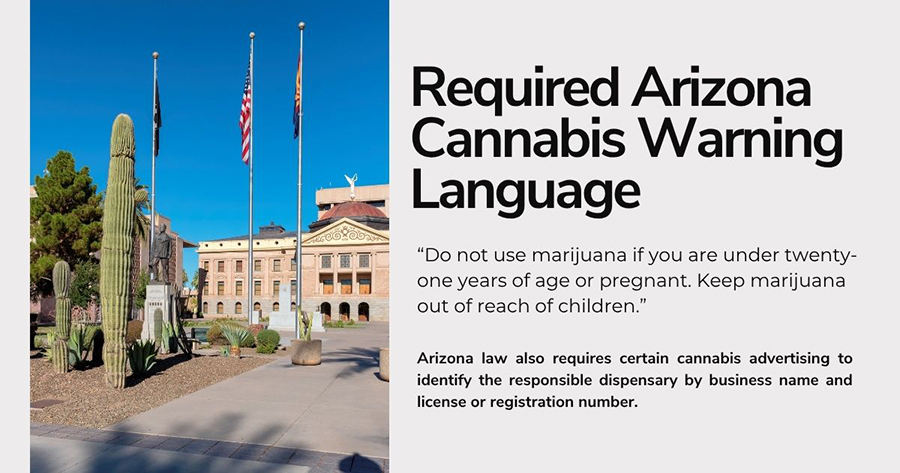
All advertising must include the following conspicuous and legible warning:
“Do not use marijuana if you are under twenty-one years of age or pregnant. Keep marijuana out of reach of children.”
Printed warnings must occupy at least 10 percent of the advertising area and appear in black font on a white background. Billboard warnings must use a font type that is at least 10 percent of the largest type in the advertisement. Advertising hosted by a platform must also identify the responsible dispensary by name and license or registration number.
We recently talked through this with one of our long-term Arizona dispensary clients, and our decision was to be as compliant as possible across the main public-facing channels. That meant putting the license number in the Instagram bio. Is that the most exciting use of limited bio space? No. But when you work in a regulated industry, compliance has to come before a cute profile.
The client also told me about a recent billboard. The license number is so long, and the warning takes up so much required space, that a large part of the billboard became compliance text instead of the marketing message. Again, that is the law, so it is what it is.
This is not something I would leave to memory. Update the actual design templates, email footers, video descriptions and approval checklists. If the warning is required, build a readable compliance block into the template from the beginning.
And honestly, if you think you are going to be cute by hiding the warning, shrinking it until no one can read it or leaving off the license number because it ruins the design, you are missing the point. A disclaimer that technically exists but is functionally invisible is not a smart workaround. It may make the intent to avoid the requirement look even more obvious.
The law specifically addresses advertisements hosted by an advertising platform. Whether every organic bio, informational page or nonpromotional communication needs the same treatment can depend on how the content is used. Our approach was not to look for the smallest possible interpretation. It was to make the licensed identity of the business clear and reduce risk. Your attorney should set the final standard for your company.
Direct Email, SMS, Chat and Messages Require Age Affirmation
Advertising that involves direct, individualized communication or dialogue must use age affirmation before the communication begins. The law allows methods such as user confirmation, birth date disclosure or similar registration methods.
That can affect email signups, SMS programs, loyalty marketing, live chat, chatbots, direct messages and forms that trigger automated outreach. Do not assume the “Yes, I’m 21” popup on the homepage automatically follows the user into every connected system.
Review where age affirmation is collected, whether it is stored with the contact record and whether the first promotional message waits until that step is complete. Older popups, imported lists and in-store signup forms are easy to overlook. Long-standing accounts often contain contacts no one remembers collecting, which is exactly why the process needs to be reviewed instead of assumed.
The law includes an exception for communications targeted only to an established customer base or requested through an opt-in with age affirmation. That is useful, but it is not a reason to treat every address sitting in Mailchimp or an SMS platform as automatically compliant. Have counsel confirm how the exception applies to your lists and workflows.
Where Cannabis Advertising Is Restricted
Cannabis advertising is prohibited at, on or within public airports, public transportation shelters, buses, trains, shuttles and trams. Cannabis billboards are also prohibited within 1,000 radial feet of child care centers, churches, substance abuse recovery facilities, public parks, public playgrounds and schools serving preschool through grade 12.
The word “radial” matters. This is not driving distance, and it is not based on whether the restricted location is visible from the billboard. I would ask the billboard company how the location was verified, save the documentation and have the placement reviewed before signing a long-term contract.
Sporting-event sponsorships are also restricted unless at least 73.6 percent of the expected audience is 21 or older or the sponsored organization provides written approval. The acknowledgment still has to follow the other advertising requirements.
Do not assume the vendor will protect you. The billboard company wants to sell space. The event wants sponsors. The publisher wants advertisers. That does not mean any of them have reviewed Arizona cannabis law or accepted responsibility for your campaign.
Be Careful With Cannabis Health Claims
The law prohibits health-related statements or claims about the effects of marijuana consumption that are known to be untrue. Cannabis businesses should already be cautious here because exaggerated medical and wellness claims can create problems beyond this one Arizona statute.
I still see language suggesting a product will cure anxiety, eliminate insomnia, treat chronic pain, replace medication or guarantee a specific result. A customer may genuinely say a product cured their pain, but repeating that testimonial in marketing can still turn it into a claim made by the business. A disclaimer does not automatically fix an unsupported promise.
There is a difference between discussing research or educating an adult consumer and promoting a specific product as a proven treatment. My rule as a marketer is simple: do not make a medical promise you cannot substantiate, and do not assume calling it “wellness content” changes what the statement actually says.
Arizona Cannabis Marketing Compliance Checklist
When we reviewed this for our client, we did not stop with the website. We looked at the full marketing footprint because that is where small, forgotten problems tend to live.
Use this printable checklist to review your website, social media, email, online menus, videos, paid media, vendors and offline advertising.
Website and online menu
- Homepage and promotional banners
- Product, category and location pages
- Online menu and third-party ordering links
- Age gate, forms, popups and live chat
- Images, video, blog content and old promotions
- Footer, warning language and license information
Social media and video
- Bios, pinned posts and profile descriptions
- Recent and older promotional posts
- Reels, Shorts, thumbnails and Story highlights
- Consumption imagery, THC-focused creative and youth-oriented design
- Influencer content, tagged content and saved templates
Email, SMS and loyalty
- Signup forms and age affirmation
- Welcome series and active automations
- Readable warning and license information
- Imported lists, old contacts and opt-in records
- Mobile display of compliance language
Local and third-party platforms
- Google Business Profile content and images
- Cannabis directories and menu providers
- Publisher profiles, event listings and sponsorship pages
- Affiliate, influencer and delivery-related listings
- Anything published in the dispensary’s name
Printed and offline materials
- Billboards and placement documentation
- Flyers, posters, printed menus and direct mail
- Event signage and sponsorship banners
- Approved templates using the required warning format
Internal process
- Approved legal business name and license number
- Exact warning language
- Written image and claims guidelines
- Audience documentation and age-verification procedures
- A final approval owner and records of each campaign
Remember, this is not a one-time audit checklist. It needs to become an ongoing system that helps ensure your company, in-house team, marketing agency and outside vendors remain compliant as new content and campaigns are created.
What Are the Penalties?
A marijuana establishment, nonprofit medical marijuana dispensary or paraphernalia seller that receives notice of a violation generally has 14 days to comply. Billboard location violations have a separate 30-day correction period. Licensed establishments may also face disciplinary action.
The law separately creates a civil penalty of $20,000 per violation for certain individuals or entities other than licensed marijuana establishments or nonprofit medical marijuana dispensaries that violate the advertising rules. It would not be accurate to say every dispensary automatically receives a $20,000 fine for every mistake, but the enforcement language is serious enough that no one should treat the correction period like a free pass.
By the time a business receives a notice, it may have to update a website, remove posts, replace graphics, fix email templates, contact vendors and document the response on a short deadline. Reviewing the marketing now is cheaper and less disruptive than scrambling later.
Cannabis Marketing Can Still Be Effective
Stricter advertising rules do not mean Arizona dispensaries have to stop marketing. They mean the strategy needs to be more thoughtful and less dependent on loopholes.
Cannabis companies can still invest in SEO, educational content, local visibility, reputation management, customer retention, community involvement, compliant photography and first-party email or SMS programs with proper opt-ins.
I have worked in digital marketing since 2005 and have spent years helping businesses in highly regulated industries. The companies that perform best long term are usually not the ones with the loudest promotions. They are the ones that consistently publish useful information, build trust, maintain a strong local presence and adapt when the rules change.
When paid advertising options are limited, the website has to do more of the work. It should answer real customer questions, rank for relevant local searches, explain what makes the dispensary different and guide adult consumers toward the next step. Learn more about our SEO and digital marketing for cannabis businesses or explore more cannabis marketing resources.
What Should Arizona Cannabis Businesses Do Next?
If you own or manage an Arizona dispensary, do not limit the review to the campaign currently running. Look at the entire marketing footprint, including old content, active automations, third-party profiles and offline materials.
Then get legal, compliance and marketing on the same page. Your attorney should define the standard. Your marketing team should turn that standard into templates, checklists and workflows that are actually followed.
At Eminent SEO, we help cannabis companies improve search visibility, website content, local presence and digital marketing while navigating the restrictions that come with the industry.
Contact us if your Arizona cannabis business needs help reviewing or updating its website, SEO, content, social media or digital strategy.
This article is provided for general informational and marketing purposes only and does not constitute legal advice. Cannabis laws and their application can be complex. Consult a qualified Arizona attorney regarding your company’s specific advertising and compliance obligations.
Sources:
- Arizona State Legislature. (2026). A.R.S. § 36-2859: Advertising; restrictions; warning; enforcement; civil penalty; exception. https://www.azleg.gov/ars/36/02859.01.htm
- Arizona House of Representatives. (2025). HB 2179: Marijuana; advertising; restrictions [Signed bill summary]. Arizona State Legislature. https://www.azleg.gov/legtext/57leg/1R/summary/H.HB2179_021125_SIGNED.DOCX.htm
- Arizona State Legislature. (2025). Chapter 166, House Bill 2179: Marijuana; advertising; restrictions [Enacted law]. https://www.azleg.gov/legtext/57leg/1R/laws/0166.htm
- Google. (n.d.). Recreational drugs: Google Ads policy. https://support.google.com/adspolicy/answer/16489299