I’ve worked in digital marketing for more than 20 years, which means I’ve watched search change a lot.
But this moment feels different.
It’s not just the technology that’s changing. We’re all learning new behaviors at the same time.
Think about how you searched a few years ago. You typed a few words into Google, opened several tabs, compared websites, and eventually made a decision.
Now, you can ask AI a detailed question, refine what you want, compare your options, and increasingly take action without following that traditional search journey at all.
And that shift is happening faster than most businesses realize.
The distance between “I need something” and “I chose something” is shrinking.
Google says AI Mode has already surpassed 1 billion monthly users. It’s also building agentic capabilities into Search that can do more than provide information. In some local service categories, Google can even contact businesses on a user’s behalf.
ChatGPT is moving in the same direction. It can help users discover restaurants, compare options, check availability, and make reservations. Shopping experiences are becoming increasingly conversational, too.
That means your next customer may not search Google, click your website, browse five pages, and fill out a form.
They may simply ask AI who they should choose.
That changes marketing in a pretty fundamental way.
At the same time, Google is still cleaning house.
Google began rolling out its August 2026 spam update this month, and the timing feels appropriate.
AI has made it ridiculously easy to create hundreds of blogs, landing pages, and other “SEO content” at scale.
But more content has never automatically meant better marketing.
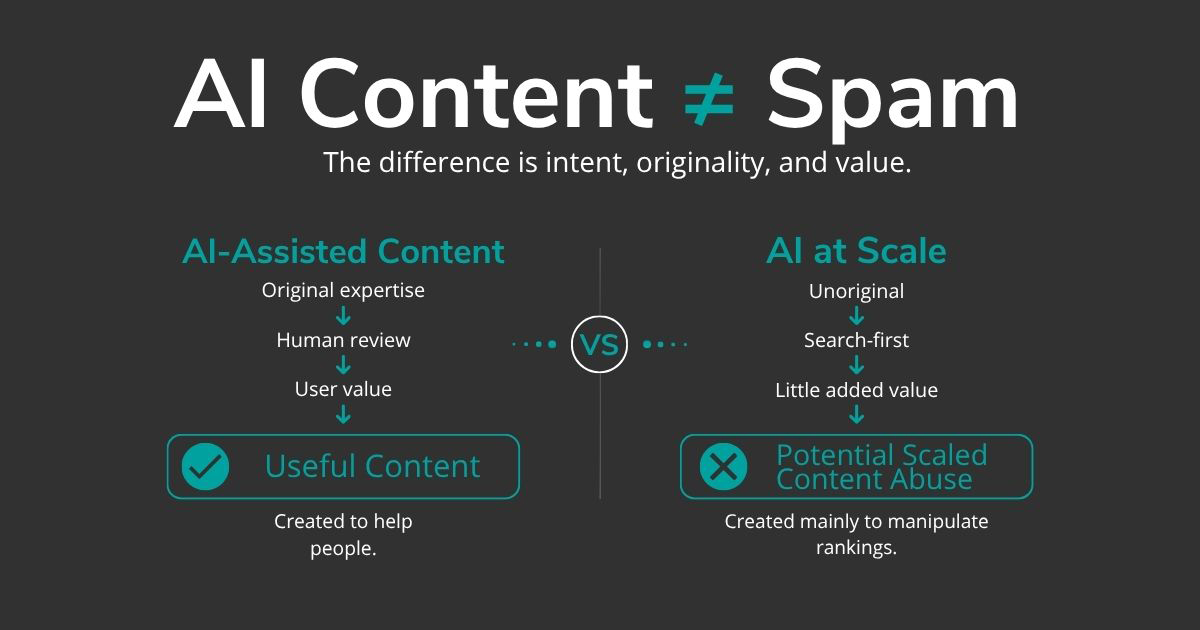
Google isn’t saying AI-generated content itself is spam. The bigger concern is content created at scale primarily to manipulate rankings without providing meaningful value.
In other words:
AI didn’t create the bad-content problem. It just made bad content a whole lot easier to produce.
And that distinction matters.
Using AI to research, brainstorm, analyze, or improve efficiency is very different from publishing hundreds of barely edited pages because you suddenly have the ability to do it.
The question businesses need to ask isn’t simply, “Was AI involved?”
A better question might be:
Would we still create this content if Google didn’t exist?
If the answer is no, it may be worth looking at why that page exists in the first place.
So, what should businesses actually do?
We don’t know exactly what search will look like three years from now. Nobody does.
But waiting until everything settles before adapting your marketing strategy doesn’t make much sense either.
The fundamentals still matter: create something useful, demonstrate real expertise, build a recognizable brand, earn trust, and make it easy for people, search engines, and increasingly AI systems to understand who you are and what you do. Rankings still matter. Traffic still matters. Leads and conversions absolutely matter.
But the picture is getting bigger.
We’re also paying closer attention to overall search presence, brand authority, AI visibility, and whether a business has enough credible signals across the web to be referenced and recommended.
Because the question is becoming bigger than:
“Do you rank #1?”
It’s becoming:
“When someone asks AI who they should trust, will it know who you are?”
Worth Knowing
A few other developments we’re watching:
AI visibility is becoming more measurable. Google has started introducing more reporting around how websites appear within its generative AI search experiences.
Advertising is following the audience. Google is developing ads for AI search experiences, and ChatGPT has begun testing advertising for eligible users.
AI is becoming an actual marketing assistant. Google is building tools that can analyze performance, recommend changes, and help marketers take action.
Some things are changing incredibly fast. And apparently, some things about the internet never change. Wherever the attention goes, the ads eventually follow.
Worried About What AI Content Means for Your Website?
We’re taking a deeper look at Google’s new spam update, what “scaled content abuse” actually means, and when AI-assisted content can become a real SEO risk.
And if you’re trying to figure out what all of these changes mean for your own marketing strategy, we’re happy to take a look. You can book a free consultation with us anytime.
CEO, Business Consultant, Researcher and Marketing Strategist
Jenny Weatherall is the co-owner and CEO of Eminent SEO, a design and marketing agency founded in 2009. She has worked in the industry since 2005, when she fell in love with digital marketing… and her now husband and partner, Chris. Together they have 6 children and 3 granddaughters.
Jenny has a passion for learning and sharing what she learns. She has researched, written and published hundreds of articles on a wide variety of topics, including: SEO, design, marketing, ethics, business management, sustainability, inclusion, behavioral health, wellness and work-life balance.
What to check if your traffic drops after a Google spam update
How to use AI for content without sacrificing quality
Why original content matters even more in AI-powered search
AI has made it possible to create more content, faster, and at a fraction of what it used to cost.
Sounds great, right?
It can be. We use AI ourselves, and we believe it can be an incredibly valuable tool for research, ideation, analysis, content development, and marketing efficiency.
But there’s a big difference between using AI to create better content and using AI simply to create more content.
With Google’s August 2026 spam update now rolling out, businesses are once again asking whether AI-generated content could hurt their rankings. It’s a fair question, especially for companies that have spent the last few years adding AI-assisted blogs, landing pages, FAQs, location pages, product descriptions, and other content to their websites.
The short answer?
AI content itself isn’t the problem. Low-value content created primarily to manipulate search visibility is.
And with AI making that kind of content easier to produce at scale, now is a very good time to look at what’s actually on your website.
Does Google Penalize AI-Generated Content
No. Google does not automatically penalize content because AI was used to create it.
Google’s guidance has remained fairly consistent on this point. Its ranking systems are intended to reward original, useful, high-quality content regardless of how it was produced. In fact, Google’s guidance on using generative AI content acknowledges that AI can be useful for research and adding structure to original content.
Google even acknowledges that generative AI can be useful for things like research and adding structure to original content.
Where things get risky is when automation is used primarily to manipulate search rankings.
Google specifically warns against using generative AI or other tools to produce large numbers of pages without adding meaningful value for users. That can violate its policy against what it calls scaled content abuse.
The distinction matters.
Using ChatGPT to help research a complicated topic before an experienced professional contributes their perspective is very different from prompting AI to “write 100 SEO blogs about personal injury law” and publishing them with minimal human involvement.
The problem isn’t simply producing a lot of content.
The problem is producing large amounts of unoriginal or low-value content primarily to manipulate search rankings rather than help users.
And Google’s policy applies regardless of how that content was produced.
AI can do it.
Humans can do it.
An outsourced content company can do it.
A combination of automation and human editing can do it.
In other words, slapping a human editor onto an AI workflow doesn’t automatically make the content valuable.
Google lists examples that include using generative AI to create many pages without adding value, republishing or transforming content from other sources without meaningful additions, combining information from multiple websites without contributing anything original, and creating large numbers of keyword-focused pages that offer little to readers.
And Google has now made clear that these spam policies don’t only apply to traditional blue-link search results. They also apply to generative AI experiences within Google Search.
That should get marketers’ attention.
The goal isn’t simply to get indexed anymore. As search evolves, businesses also want their brands and information to be understood, trusted, referenced, and potentially surfaced within AI-generated experiences.
Creating a mountain of commodity content isn’t a shortcut to getting there.
When Does AI Content Become an SEO Risk?
There isn’t a magic percentage of AI-generated copy that suddenly makes a page bad.
Instead, look at what the content contributes.
Some warning signs are fairly easy to spot.
Hundreds of Similar Location Pages
There are legitimate reasons for a multi-location business to have individual location pages. Customers need addresses, hours, directions, services, staff information, photos, reviews, and other locally relevant information.
But creating 100 nearly identical pages and swapping “Phoenix” for “Scottsdale” for “Tempe” isn’t suddenly a local SEO strategy because AI made it easy.
Each page should have a legitimate purpose and offer information relevant to the people in that market.
They summarize information that already exists on hundreds of other websites without adding firsthand knowledge, an expert perspective, original research, examples, experience, or anything else that makes the article worth reading.
AI didn’t invent this type of content.
It just made it much easier to produce.
Content Created for Every Possible Keyword Variation
This is particularly important as businesses begin optimizing for AI search.
It may be tempting to create a separate page for every question, conversational phrase, long-tail keyword, or possible AI prompt someone might use.
Google specifically cautions against this approach.
Modern search systems are much better at understanding meaning and relevance without requiring an exact-match page for every variation of a query.
You don’t need 75 pages saying essentially the same thing.
You need the best resource you can reasonably create around the subject.
“Best” Lists With No Real Basis
AI can produce a “10 Best Anything in Any City” article in seconds.
But why should anyone trust it?
Was anything actually tested? Were the businesses evaluated? What methodology determined the rankings? Does the publisher have experience with the products or services?
If the only reason the article exists is to capture a search query, that should raise questions before you publish it.
Content Outside Your Actual Expertise
This can become especially problematic for businesses publishing at scale.
A website develops authority in one area, discovers adjacent keywords with high search volume, and suddenly starts publishing hundreds of articles on topics barely related to the business.
AI makes that expansion incredibly easy.
But easy doesn’t mean strategic.
Your content should reinforce who you are, what you know, and why someone should trust you.
A Simple Question to Ask Before You Publish
There are plenty of technical ways to audit content, but one question cuts through a lot of the noise:
Would we still create this content if Google didn’t exist?
Would you still create this content if Google did not exist? AI content strategy question
Not every SEO-focused page will pass that test literally. Search demand is a perfectly legitimate reason to identify topics people care about, and keyword research still has an important role in content strategy.
The question is really about intent.
If someone arrived at this page directly, would it help them?
Would you be comfortable sending it to a prospective customer?
Does it demonstrate something your company actually knows?
Does it provide information that isn’t already available everywhere else?
Would anyone notice if it disappeared from the internet tomorrow?
That last one can sting a little.
But if the answer is no, producing another 50 pages just like it probably isn’t the solution.
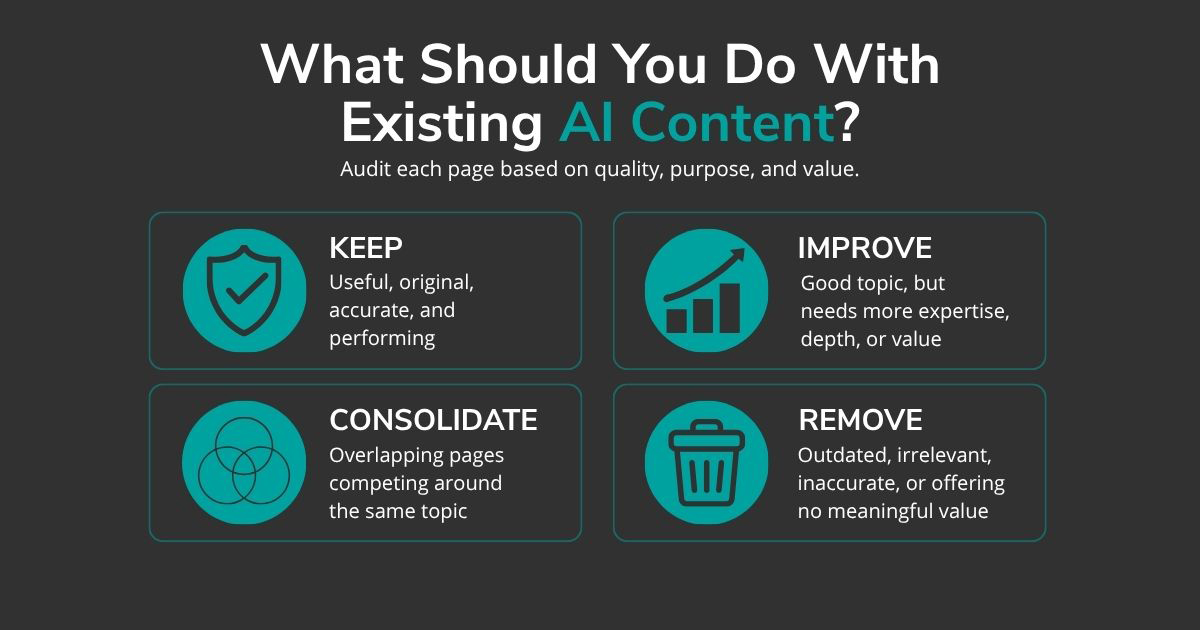
What Should You Do With Existing AI Content?
If your company has already published AI-assisted content, don’t panic and start deleting everything.
AI involvement alone is not a reason to remove a page.
Instead, audit the content based on quality, purpose, performance, relevance, and value.
Start by looking for patterns.
Do you have large groups of pages receiving no impressions or traffic?
Are multiple articles competing around essentially the same topic?
Do you have old posts that no longer reflect your expertise or current services?
Are there pages that read well but don’t actually say anything original?
Does the information remain accurate?
Can you identify who the content was intended to help and what they should gain from it?
From there, decide what each page deserves.
Some content may simply need updating. Some articles can be consolidated into a much stronger resource. Some pages need additional expert input, examples, statistics, visuals, or firsthand experience.
And yes, some content probably needs to go.
The goal isn’t to protect every URL you’ve ever published.
The goal is to make the website stronger as a whole.
Did the August 2026 Spam Update Affect Your Website?
If your organic traffic or rankings decline during a Google update, resist the urge to immediately start changing everything.
Algorithm updates can create volatility, and short-term movement doesn’t necessarily indicate a lasting problem.
Start with the data.
Compare organic search performance year over year where possible so seasonal changes don’t get mistaken for an algorithmic decline.
Review Google Search Console to determine whether impressions and clicks changed across the entire site or within particular directories, topics, pages, or queries.
Look at conversions, leads, and revenue alongside rankings and traffic. A decline in keyword count does not necessarily mean the business lost meaningful visibility.
And give the update enough time to roll out before drawing sweeping conclusions.
If there is a sustained decline associated with a spam update, then it’s time for a deeper review of Google’s spam policies and your website.
That review shouldn’t stop at AI content, either. Google’s spam policies address a much wider range of practices, including doorway abuse, link spam, site reputation abuse, expired domain abuse, cloaking, and other manipulative tactics.
Correlation is not diagnosis.
So, Should Businesses Stop Using AI for Content?
Absolutely not.
That’s not realistic, and we don’t think it’s necessary.
The better question is: What role should AI play in your content process?
The goal should be to incorporate AI into a thoughtful content marketing strategy, not use it as a replacement for strategy altogether.
AI can be incredibly useful for:
Research and discovery
Brainstorming topics and angles
Organizing information
Identifying questions audiences may have
Analyzing large amounts of data
Creating initial outlines
Improving workflows and efficiency
Repurposing existing original material
Helping subject matter experts turn their knowledge into usable content
But somebody still needs to think.
Someone needs to determine why the content should exist, whether it’s accurate, what perspective the brand brings to the conversation, and whether the finished product is actually worth publishing.
That’s the part businesses shouldn’t automate away.
AI Search Makes Originality More Important, Not Less
There’s another reason this conversation matters beyond Google’s spam updates.
Search itself is changing.
AI Overviews, AI Mode, ChatGPT, and other generative search experiences can synthesize information from multiple sources and answer increasingly complicated questions without requiring users to visit ten different websites.
That creates a pretty obvious problem for commodity content.
If your article merely summarizes information AI can already summarize itself, why does the user need your article?
This is where experience, expertise, original data, unique perspectives, strong brands, and trusted sources become even more valuable.
The internet doesn’t need another generic definition.
It needs something worth referencing.
And businesses need to think beyond creating pages that rank to creating information that search engines, AI systems, journalists, customers, and other websites have a reason to trust and cite.
The Future of Content Isn’t Human vs. AI
We’ve spent a lot of time debating whether humans or AI should create content.
We think that’s the wrong debate.
The real divide is between content that contributes something and content that doesn’t.
A terrible article doesn’t become valuable because a human spent six hours writing it.
And an excellent resource doesn’t become worthless because AI helped organize the research.
The opportunity is in combining technology with the things technology can’t manufacture on its own: your company’s experience, customer insights, proprietary data, opinions, examples, creativity, and expertise.
Use AI to make your team better.
Don’t use it to make more internet.
The Bottom Line
AI content isn’t inherently putting your website at risk.
Bad content is.
The difference is that AI now allows businesses to create bad content at a scale we couldn’t have imagined a few years ago.
Google’s spam policies make its position fairly clear: creating large amounts of low-value content primarily to manipulate search visibility can violate its guidelines, regardless of whether that content came from AI, humans, or both.
So before you ask whether your company should be creating more content with AI, ask a better question:
Do we have something worth saying?
If the answer is yes, AI can be an incredibly powerful tool for helping you say it.
If the answer is no, hitting “generate” another hundred times probably isn’t going to fix the problem.
Concerned About Your Website’s Content Strategy
If you’re unsure whether your existing content is helping your visibility or creating unnecessary risk, learn more about our SEO and organic marketing services. We can evaluate your website, search performance, AI visibility, and overall content strategy to identify what’s working, what isn’t, and where there are opportunities to improve.
We’ll look at what’s working, what isn’t, and where there are opportunities to build stronger content around the expertise and authority your business already has.
CEO, Business Consultant, Researcher and Marketing Strategist
Jenny Weatherall is the co-owner and CEO of Eminent SEO, a design and marketing agency founded in 2009. She has worked in the industry since 2005, when she fell in love with digital marketing… and her now husband and partner, Chris. Together they have 6 children and 3 granddaughters.
Jenny has a passion for learning and sharing what she learns. She has researched, written and published hundreds of articles on a wide variety of topics, including: SEO, design, marketing, ethics, business management, sustainability, inclusion, behavioral health, wellness and work-life balance.
Rank for the right keywords. Drive traffic. Generate leads.
While rankings still matter, Google’s recent announcements suggest we’re entering a new phase of search where recognition, trust, and authority play a much larger role in determining visibility.
Between AI-generated answers, Google’s Preferred Sources feature, and ongoing guidance around creating original content, the message is becoming increasingly clear:
The businesses that win tomorrow may not be the ones publishing the most content. They may be the ones that become recognized as trusted sources.
Google’s Preferred Sources: A New Signal of Trust
Google recently expanded its Preferred Sources feature, allowing users to identify publishers and websites they trust.
This is a fascinating development because it shifts some influence away from algorithms alone and toward audience preference.
In other words, Google isn’t just asking, “What ranks?”
It’s increasingly asking, “Who do people trust?”
The End of Commodity Content
One phrase keeps showing up in Google’s recent guidance: non-commodity content.
If everyone is publishing the same article, using the same talking points, and relying on the same AI-generated summaries, why should Google surface one version over another?
Businesses should focus on:
Original insights
Real-world experience
Unique perspectives
Proprietary data
Thought leadership
What the May Core Update Is Really About
What Businesses Should Do Now
The goal isn’t to publish more content.
The goal is to become a source worth referencing.
Ask yourself:
What unique expertise does our business have?
What questions can we answer better than competitors?
What experiences can we share that AI cannot replicate?
How can we build a recognizable and trusted brand?
Those answers may become more valuable than any individual ranking.
If you’re evaluating how AI search, authority signals, and changing user behavior may impact your visibility, our team can help. Book a Free Consultation
The Rise of the Trusted Source
I’ve been watching Google’s recent announcements around AI search, Preferred Sources, content quality, and authority signals, and I keep coming back to the same conclusion: search is becoming increasingly focused on trust.
Rankings still matter, but they’re no longer the whole story. Businesses that build expertise, recognition, and credibility are likely to have an advantage as search continues to evolve.
I explore this idea in more detail in my latest article, The Rise of the Trusted Source: How Google, AI Search, and User Behavior Are Changing Online Visibility.
CEO, Business Consultant, Researcher and Marketing Strategist
Jenny Weatherall is the co-owner and CEO of Eminent SEO, a design and marketing agency founded in 2009. She has worked in the industry since 2005, when she fell in love with digital marketing… and her now husband and partner, Chris. Together they have 6 children and 3 granddaughters.
Jenny has a passion for learning and sharing what she learns. She has researched, written and published hundreds of articles on a wide variety of topics, including: SEO, design, marketing, ethics, business management, sustainability, inclusion, behavioral health, wellness and work-life balance.
Sixteen years. That’s wild to even say out loud. When we started Eminent SEO back in 2009, it was just a few friends, a Hotmail account, an Excel sheet, and a lot of grit (and caffeine). No office, no funding, no fancy tech – just a belief that we could build something real. Something better.
A lot has changed since then. We’ve gone from late nights building links to developing brand portfolios, content systems, creative campaigns, and ROI-driven marketing strategies. We’ve seen platforms rise and fall, algorithms rewrite themselves, and the digital world reinvent how business works more times than we can count.
But through it all, the core stayed the same: good people doing great work.
16 Lessons from 16 Years in Business
Sixteen years in business means a lot of coffee, a lot of Google updates, and a lot of learning. Some lessons came easy. Others… not so much.
But every one of them helped shape who we are: as people, as marketers, and as a team.
Here are a just few of the things we’ve learned along the way:
Heading into our 17th year, our focus is simple: keep creating work we’re proud of, keep helping our clients grow, and keep building a company that cares about people as much as performance.
To our clients, team, and friends who’ve been part of this wild ride: thank you! You’re the reason we get to do what we love every day.
Sixteen years down, and it’s only up from here!
AI, SEO & LLMs: The Future of Search
Large language models like ChatGPT and Gemini are changing how people search and consume information.
It’s not about ranking for keywords anymore – it’s about showing up in the AI-generated answers.
That means adopting AEO (Answer Engine Optimization) and GEO (Generative Engine Optimization) so content is structured, machine-readable, and ready for AI to pull in.
“We’ve been through so many changes, but one thing that never changes is that it’s all about the people. You can have great players, but if they can’t play together, you’re not going to make it.”
Jenny Weatherall
Featured Service
AI Marketing & SEO Optimization (GEO)
We help brands stay visible in AI-driven search by optimizing for Google AI Overviews, ChatGPT, Gemini, and more. Our Generative Engine Optimization approach blends AI tools with human expertise to structure, personalize, and future-proof content – so it’s ready to appear in both traditional search results and AI-generated answers.
Eminent SEO provides strategic SEO campaigns with measurable results along with expert website design, development, pay per click, content and social media and organic website marketing. 800.871.4130.
Google’s AI Mode may become the default, but Google says not just yet.
Welcome to GEO (Generative Engine Optimization) – a new way to optimize for visibility in AI-generated answers. What is GEO?
GEO performance is hard to measure – we explain what shows up, what doesn’t, and what to do about it. Measuring GEO
We break down what you can measure, what you can’t, and how to optimize anyway.
AI continues to reshape the way we think about content, search, and visibility – but it’s not always clear what’s signal and what’s noise.
Last week’s back-and-forth from Google about AI Mode becoming the default search experience sent SEOs into overdrive. Some insiders say it’s “coming soon.” Others say, “don’t read too much into that.” Either way, one thing is certain:
AI-powered search is here, and we need to be optimizing for it now, not later.
AI Mode May Become the Default Search Experience (Or… Maybe Not Just Yet)
Google’s AI Mode is now live at google.com/ai, offering AI-powered answers, comparisons, and follow-up questions in a cleaner, more “conversational” interface.
Yes, Logan Kilpatrick (Google PM) said it would become the default “soon,” but VP Robby Stein clarified not to read too much into that. So for now, AI Mode is opt-in – but growing fast.
As it spreads, it’s bringing a new challenge: How do you measure visibility and impact when clicks disappear and citations replace rankings?
GEO: What We Can and Can’t Track (Yet)
Generative Engine Optimization (GEO) is the emerging practice of optimizing content to show up in AI-generated responses – whether in Google AI Overviews, ChatGPT, Perplexity, or Gemini.
But here’s the kicker: visibility doesn’t mean traffic, and performance data is murky at best.
What’s trackable right now:
AI mentions and citation rate: Tools are emerging to track when your brand is cited in generative answers. High citation = the new “Position 1.”
Referral traffic from generative engines: Some platforms link back to your site. You can segment this traffic, though it’s messy.
Share of voice in AI answers: How often your brand shows up in response to core queries.
Content prominence: Where you appear in the AI response (first bullet? buried in a footnote?).
What’s still missing:
Prompt volume: Unlike keyword search, generative engines don’t show how many people ask about your topic.
Why a citation happened: You might know you were cited, but not what triggered it.
Attribution blending: When multiple sources are synthesized, you don’t know how much credit your content gets.
The visibility you gain may not show up in GA or GSC, but that doesn’t mean it’s not influencing behavior.
“Act as a generative engine. Here’s my article. Would you cite it in response to this question? Why or why not?”
Tool to Watch:
We’re testing new AI SEO tools that track brand mentions in AI responses across ChatGPT, Perplexity, and Google AI. Hit us up if you want our shortlist.
Final Word
GEO isn’t about chasing rankings, it’s about earning trust from machines. That means clarity, consistency, and credibility are your most important assets. The next wave of SEO success belongs to brands who can show up, even when there’s no click.
The SEO Strategy Reset
The old tactics - keyword stuffing, chasing backlinks, and posting for posting’s sake - no longer deliver real results. With AI answering users directly in search, content without original insight and value simply won’t be seen.
What’s working now:
focused content clusters, experience-driven perspectives, structured data, lightning-fast mobile performance, and building true user trust over vanity metrics.
Large language models like ChatGPT and Gemini are changing how people search and consume information. It’s not about ranking for keywords anymore - it’s about showing up in the AI-generated answers.
That means adopting AEO (Answer Engine Optimization) and GEO (Generative Engine Optimization) so content is structured, machine-readable, and ready for AI to pull in.
We’re rethinking how content is created - clear question-and-answer formats, robust schema markup, and entity-based optimization so AI systems can easily understand and recommend it.
I’m also leveraging AI tools to audit and refine content, making sure it stays competitive even in zero-click environments.
When someone on X (formerly Twitter) said AI Mode should be the default, a Google Product Manager for AI, simply replied:
“soon :)”
Logan Kilpatrick
Featured Service
AI Marketing & SEO Optimization (GEO)
We help brands stay visible in AI-driven search by optimizing for Google AI Overviews, ChatGPT, Gemini, and more. Our Generative Engine Optimization approach blends AI tools with human expertise to structure, personalize, and future-proof content - so it’s ready to appear in both traditional search results and AI-generated answers.
Eminent SEO provides strategic SEO campaigns with measurable results along with expert website design, development, pay per click, content and social media and organic website marketing. 800.871.4130.
The AI Takeover: What It Means for Your SEO, Strategy, and Search Visibility
Hi There!
I’ve been digging deep into where search is headed – reading, researching, and testing – and one thing is clear: the SEO playbook we’ve all relied on has changed dramatically.
I recently pulled together three articles on our blog that explore what’s happening. Here’s the condensed takeaway:
The SEO Strategy Reset
The old tactics – keyword stuffing, chasing backlinks, and posting for posting’s sake – no longer deliver real results. With AI answering users directly in search, content without original insight and value simply won’t be seen.
What’s working now:
focused content clusters, experience-driven perspectives, structured data, lightning-fast mobile performance, and building true user trust over vanity metrics.
Large language models like ChatGPT and Gemini are changing how people search and consume information. It’s not about ranking for keywords anymore – it’s about showing up in the AI-generated answers.
That means adopting AEO (Answer Engine Optimization) and GEO (Generative Engine Optimization) so content is structured, machine-readable, and ready for AI to pull in.
We’re rethinking how content is created – clear question-and-answer formats, robust schema markup, and entity-based optimization so AI systems can easily understand and recommend it.
I’m also leveraging AI tools to audit and refine content, making sure it stays competitive even in zero-click environments.
Bottom line: SEO hasn’t disappeared – it’s evolved. Now it’s about depth, structure, authority, and AI-readiness. The agencies that adapt early will lead the way for their clients in this new search landscape.
If you’re curious about the full articles or want to share your own thoughts, just hit reply – I’d love to compare notes.
Here’s to building the next era of search,
Jenny Weatherall, CEO
Eminent SEO
Quote of the Month:
“We’re not on version 2.0 anymore, we’re at SEO 25.0”
Chris Beckley
Featured Service
AI Marketing & SEO Optimization (GEO)
We help brands stay visible in AI-driven search by optimizing for Google AI Overviews, ChatGPT, Gemini, and more. Our Generative Engine Optimization approach blends AI tools with human expertise to structure, personalize, and future-proof content – so it’s ready to appear in both traditional search results and AI-generated answers.
Eminent SEO provides strategic SEO campaigns with measurable results along with expert website design, development, pay per click, content and social media and organic website marketing. 800.871.4130.
Search just shifted again. Google rolled out its June 2025 Core Update, and this one could be big. Not only is it rooted in AI advancements, but the messaging from Google hints that smaller, previously underrecognized sites may now get more visibility. That’s good news for high-quality niche content creators.
We’re also watching Google’s latest AI-powered ranking systems and something called MUVERA that might change how websites are discovered altogether.
Let’s dive into what this means, and how to stay ahead.
Google’s June 2025 Core Update: What You Need to Know
Google just announced its June 2025 Core Update, calling it “a regular update designed to better surface relevant, satisfying content for searchers from all types of sites.” That last part is key, Google may be shifting toward more diversity in what it surfaces, potentially giving a boost to smaller or lesser-known sites.
What’s behind this? Likely more AI advancement.
Here’s what we’re watching:
MUVERA (Multi-Vector Embedding Retrieval Architecture) – Google says it’s now easier to precisely retrieve and re-rank content using neural embeddings.
Expect results to feel more context-aware and exact.
Timing suggests the update aligns with or is leading up to a new version of Gemini AI.
Our take: Content relevance and satisfaction signals are more important than ever. Sites that focus on helpful, nuanced content will have an edge – especially if they’re optimized for semantic and vector-based search retrieval.
Let’s Talk Strategy:
While many SEOs are scrambling to adapt, here’s your edge, focus on:
Topical authority – Publish content clusters that deeply explore your subject matter.
Clear structure – Help search engines understand your content with headers, internal links, and clean formatting.
User experience – Fast load times, accessible design, and satisfying content = better rankings.
Gemini updates drive SEO shifts: Most recent core updates have dropped within 1–2 weeks of major Gemini model releases.
Structured content matters: Google’s AI is improving at identifying sections of content that meet search intent – make yours scannable and structured.
Featured Blog Post
Adapting Your SEO Strategy for AI-Driven Search
As Google’s ranking systems evolve, so should your SEO strategy. In our latest post, we explore what AI-powered search really means—breaking down MUVERA, Gemini, and how semantic relationships are reshaping search results. Whether you’re a business owner or a strategist, this is your roadmap to staying visible in the age of AI.
Eminent SEO provides strategic SEO campaigns with measurable results along with expert website design, development, pay per click, content and social media and organic website marketing. 800.871.4130.
Lately, I’ve been in conversations with clients, teammates, and even competitors, and one thing’s become clear: SEO as we knew it is gone. It’s not dramatic. It’s just the truth. Google is rolling out features faster than most people can follow, but that’s what we’re here for.
This month, I’m keeping it tight. Just the key insights we’re acting on – the ones worth your time and energy.
Let’s get into it.
AI Mode is Here.
And It Doesn’t Care About Your Rankings
Google’s AI Overviews (also called AI Mode) are live and already changing visibility for millions of keywords.
What we’re seeing:
Only about 13 percent of keywords triggered an AI Overview in March, but the number is growing.
Most URLs featured in AI Mode are not ranked in the top 10 organic results.
AI Mode goes deep. It doesn’t just pull what ranks well; it pulls what answers the question well.
What’s working now:
Structured content with clear takeaways
Pages that include custom visuals
Original, helpful perspectives instead of summaries or rehashed information
Tip: Don’t optimize for keywords. Optimize for the kinds of questions people are really asking.
150 Days or You’re Out
New research confirms that if Google hasn’t crawled your page in 150 days, it likely won’t get indexed.
This is affecting new content, low-authority URLs, and older posts that haven’t been updated or linked to.
What we’re doing for clients:
Running internal linking audits
Checking sitemap and GSC health
Refreshing and republishing content worth keeping
Need help identifying what’s been left behind? Just reply.
“Menu-Based” SEO is the Move
Seth Godin said, “People prefer multiple choice to essay exams.”
This applies to AI tools and user experience. If you’re relying on users or AI to guess what to do next, engagement drops.
How we’re adjusting:
Adding “Ask Me” style prompts under blog sections
Including TLDRs and step-by-step guides
Designing content with modular answers and interaction points
Quick Fix of the Month
Open Google Search Console, go to Crawl Stats.
Look at when your most important pages were last crawled. If it’s been more than 60 days, flag it.
Those pages may be at risk.
Prompt of the Month
Use this in Gemini or ChatGPT to identify content gaps:
“Review this article and tell me what a user would still be confused about after reading it. Suggest content I can add to improve clarity and make it AI Mode-friendly.”
What We Believe Right Now
AI Mode will eventually replace traditional search
Content that includes original insights, structure, and visuals will perform better
Helpful content means anticipating the next question before it’s asked
If your content isn’t truly helping, teaching, or inspiring, AI isn’t likely to surface it.
Final Word
If your content has lost visibility recently, it’s not your fault.
The rules changed. The good news is, we’re already adapting.
If you need help with the next step, we’re ready.
Jenny Weatherall
Featured Service
Data and insights from the SEO audit form the foundation of an SEO strategy. This includes developing a brand’s buyer personas and identifying what their ideal audiences is looking for when they browse the Web. This information can be developed into a website information architecture that satisfies search engines while delighting users.
Eminent SEO provides strategic SEO campaigns with measurable results along with expert website design, development, pay per click, content and social media and organic website marketing. 800.871.4130.
Hey There,
Q2 is here already – if you’re feeling like Q1 flew by and you’re still waiting for your marketing to “click,” you’re not alone. A few smart adjustments this month could make a real difference in how you finish the first half of the year.
Here’s what we’re seeing and what you should be paying attention to right now.
Let’s Talk AI + Search
A few key shifts are happening – and they’re big.
AI Overviews are showing up more often in Google results since the March core update. That means fewer clicks for some sites. If your traffic dipped, this might be why.
You can now track traffic from tools like ChatGPT. If LLMs are quoting or referencing your site, it’s measurable now (thanks to a great Looker Studio template – hit us up if you want it).
Gemini 2.5 is live and powering a lot of these changes. It’s smarter and more context-aware, so the quality bar for content just got higher.
Bottom line: If your site is full of generic, keyword-stuffed content, it’s time to rewrite it – or risk losing visibility
SEO: Local Tips That Still Work
Old-school still wins when done right:
Add your business address to the footer of your site – even if you’re a service-area business. People are testing this and seeing boosts in both organic and local rankings.
Simple fix, real results.
Email: What’s Getting Opens Right Now
Short, helpful, personal. That’s what’s working.
Over-designed emails are underperforming. The more your email looks like a sales flyer, the more it gets ignored.
People want useful info – not just discounts. Give them tips, insights, behind-the-scenes stuff. That builds trust and keeps you top of mind.
What You Should Do in April
If you do nothing else this month:
Refresh 2–3 top-performing pages on your site
Check site speed and fix what’s slowing it down
Segment your email list and test new subject lines
Revisit your lead gen flow – what’s working, what’s not?
Need help? You don’t have to guess. We’re doing this stuff every day, and we’d love to help you move the needle. Reply to this email and let’s talk strategy.
Until next time,
Jenny Weatherall & the Eminent SEO Team
Featured Service
Powerful Email and Newsletter Marketing Services
Here at Eminent SEO, we offer email marketing services to help you stay in constant contact with your prospects, supply them with enticing offers and share useful information about your company. A smart email marketing campaign includes great branding, impactful design, focused content and established tracking metrics. We can help you do it all.
Eminent SEO provides strategic SEO campaigns with measurable results along with expert website design, development, pay per click, content and social media and organic website marketing. 800.871.4130.
Q1 is moving fast, and if you’re not seeing the leads or results you expected, it’s time to pivot. We’ve been tracking SEO updates, email marketing strategies, and Google’s latest changes, and here’s what you should be focusing on this month.
No fluff – just actionable insights.
Good to Know in SEO & Digital Marketing
Staying ahead of search engine and marketing changes is key to long-term success.
Here’s what’s happening right now:
Google Cracks Down on ‘Parasite SEO’ – Google is penalizing sites that host unrelated third-party content (think spammy affiliate pages). If your SEO strategy involves third-party content hosting, it’s time to rethink your approach. (The Verge)
Authentic, Human Content Is Winning – Google and users are favoring real, human-written content over AI-generated spam. If you’re relying too heavily on AI to create content, make sure you’re adding real expertise and value. (Wired)
AI Search & SEO Are Evolving – Google’s Gemini 2.0 and AI-powered search are changing how search results work. The focus? More intent-driven results with less reliance on traditional rankings. If you’re not adapting, you’ll start falling behind. (Forbes)
Your Website: Is It Helping or Hurting Your Business?
Your website should be a sales tool, not just a digital brochure. If it’s not bringing in leads, it’s time to fix what’s broken.
Speed matters. If your site is slow, visitors leave. Run a speed test (Google PageSpeed Insights is free) and fix anything that’s slowing it down.
Are your calls to action clear? If someone lands on your homepage, is it obvious what they should do next? Make sure your CTAs are easy to see and use.
Content needs to stay fresh. Google rewards updated content. If you haven’t touched your top-performing pages in over a year, update them now.
What to do this month:
Run a site speed test and fix issues.
Check your forms—are they simple and working?
Look at your top 10 landing pages and make sure they’re optimized for conversions.
[/su_lis]
Email & Automation: Stop Letting Leads Slip Away
Most businesses don’t need more leads—they need to convert the ones they already have.
Automate your follow-ups. Most people won’t buy or book on the first visit. A well-timed follow-up email can make the difference.
Segment your list. Not every subscriber should get the same message. Personalization increases open rates and sales.
Improve your email engagement. If your open rates are low, test new subject lines. If clicks are low, simplify your emails and focus on one clear call to action.
What to do this month:
Set up automated emails for new leads.
Test a new subject line strategy.
Clean up your email list—remove inactive subscribers.
Content & Social Media: Less Noise, More Impact
If you’re posting all the time and getting nothing in return, it’s time to rethink the strategy.
Post less, but better. One well-thought-out post will do more for your business than five generic ones.
Repurpose your best content. If a blog is performing well, turn it into an email, LinkedIn post, or short video.
Use video, but keep it simple. You don’t need fancy production—quick insights and behind-the-scenes content go further.
What to do this month:
Look at what’s working and do more of it.
Repurpose your best-performing content.
Test a short-form video, even if it’s just a quick business tip.
The One Thing to Prioritize in March
If you do nothing else this month, optimize your website and automate lead follow-ups.
A slow site and a messy sales funnel are costing you business. Fix them now.
Need help figuring it all out? Reply to this email and let’s chat.
Until next time, Jenny & the Eminent SEO Team
Featured Service
High Quality Website Design and Development
When it comes to design, quality is everything. But, a quality website design is much more than aesthetic. It’s the usability. The expandability. The flexibility. The longevity. The creativity. We believe that a great website requires clean, responsive code, user friendly navigation search engine optimized page content and beautiful designs.
Eminent SEO provides strategic SEO campaigns with measurable results along with expert website design, development, pay per click, content and social media and organic website marketing. 800.871.4130.


 Search Is Changing Again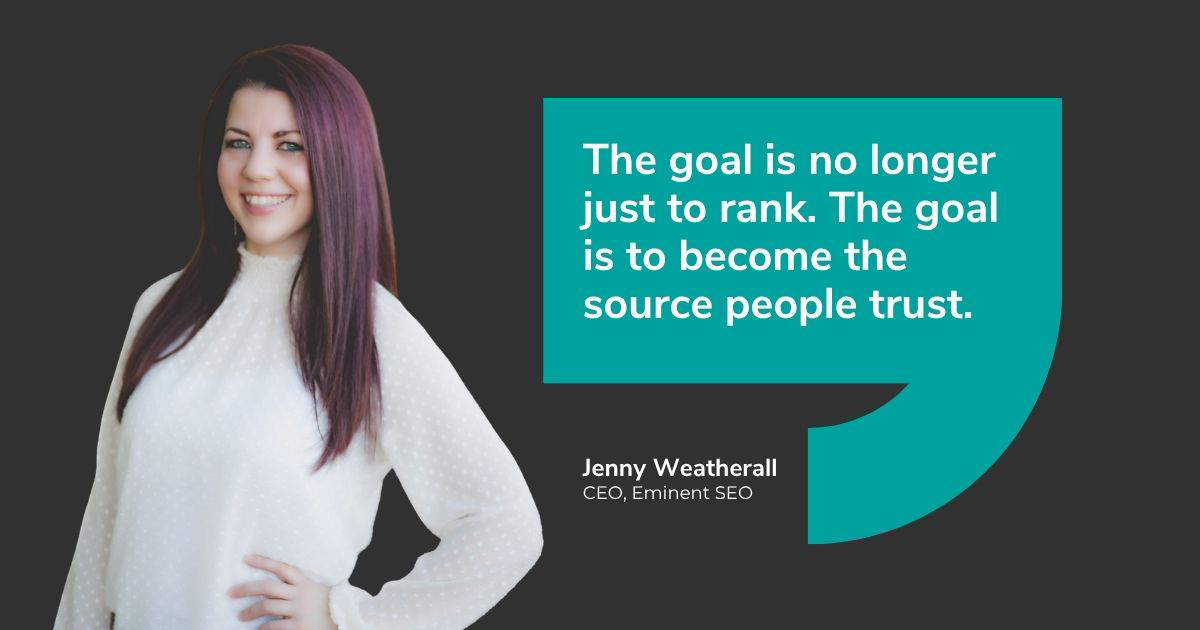









 High Quality Website Design and Development