If your SEO strategy still looks like it did a year ago, you’re not just behind. You’re operating in a completely different version of search.
Google isn’t just ranking websites anymore. It’s answering questions, guiding decisions, and in some cases, removing the need for users to click at all.
And with the rise of AI Overviews, conversational search, and task-driven AI agents, the way people find and choose businesses is changing fast.
This isn’t another “AI is coming” conversation. It’s already here, and it’s rewriting the rules of visibility, traffic, and what it actually means to show up in search.
If you’re still catching up on how AI, SEO, and large language models intersect, we broke that down in more detail here.
The Shift from Search Engine to Answer Engine
For years, SEO was built around one core goal: get the click.
Rank higher, earn the visit, guide the user through your site, and convert.
That model is starting to break.
Google is no longer just a search engine. It’s becoming an answer engine. With AI Overviews and enhanced results, users are getting what they need directly on the results page without ever clicking through.
In some cases, they’re not even seeing your site. They’re seeing a summarized version of it.
That changes the game.
Visibility is no longer just about ranking in position one. It’s about being included in the answer itself. If your content isn’t structured, trusted, and relevant enough to be pulled into those AI-generated responses, you’re invisible in a whole new way.
And this is where a lot of strategies are falling short.
Many businesses are still optimizing for traffic volume while ignoring how users are actually interacting with search today. They’re measuring success by clicks, when in reality, influence is happening before the click ever occurs.
That doesn’t mean SEO is less valuable. It means the definition of success is shifting.
Being found still matters. But now, being referenced, summarized, and trusted by the algorithm matters just as much, if not more.
Search Is Now a Conversation

Search used to be simple. A user typed in a query, scanned a list of results, clicked one, and either found what they needed or went back and tried again.
That linear behavior is fading.
Today, search looks a lot more like a conversation. Users ask a question, refine it, follow up, and explore related angles, all within the same experience. Google is leaning into this with AI-driven results that anticipate the next questions and guide users deeper without forcing them to start over.
That shift has major implications for how content needs to perform.
Optimizing a page for a single keyword or a single intent is no longer enough. Users aren’t thinking in isolated searches. They’re thinking in sequences.
They want:
- context
- comparisons
- clarification
- validation
And they expect to get it quickly.
Content that wins in this environment doesn’t just answer one question. It supports the entire journey around that question. It anticipates what comes next and builds trust as the user moves through their decision-making process.
This is where a lot of traditional SEO content falls apart.
Pages built around one keyword, one definition, or one shallow answer don’t hold up in a conversational search experience. They don’t provide enough depth to keep the user engaged, and they’re less likely to be surfaced in AI-driven responses that prioritize completeness and usefulness.
The shift here is subtle but important.
It’s not about creating more content. It’s about creating connected, thoughtful content that actually mirrors how people think and search now.
There Is No “One Ranking” Anymore
For a long time, SEO had a clear scoreboard.
You tracked rankings. You watched the movement. You celebrated when you hit position one.
Simple enough.
That clarity is starting to disappear.
Search results are becoming increasingly personalized. What one user sees isn’t necessarily what another user sees, even for the exact same query. Location, behavior, search history, device, and even context from other Google products are shaping the results in real time.
Which means your “ranking” is no longer a fixed position. It’s a moving target.
This creates a disconnect for a lot of businesses.
Reports might show strong rankings, but traffic isn’t matching expectations. Or visibility looks stable, but conversions are inconsistent. It’s not always a performance issue. Sometimes it’s a reality issue. The environment itself has changed.
And yet, many strategies are still built around outdated assumptions.
Tracking a handful of keywords and calling it success doesn’t reflect how search actually works anymore. It misses the bigger picture of how often your brand appears, how it’s being presented, and whether it’s influencing decisions across different user experiences.
This doesn’t mean rankings are irrelevant. They still matter. But they’re no longer the full story.
What matters more now is overall search presence. Are you showing up across variations of a query? Are you included in AI-generated answers? Are you building enough authority that Google consistently pulls from your content?
Because in a personalized, AI-driven search landscape, visibility isn’t one position. It’s everywhere you appear and how often you’re part of the conversation.
Why Most AI Content Is Already Failing
AI didn’t ruin content.
But it definitely made it easier to flood the internet with bad content at scale.
And we’re already seeing the impact.
There’s been a massive surge in AI-generated blogs, landing pages, and “SEO content” that all kind of say the same thing. It’s technically correct. It’s readable. It checks a few boxes.
But it doesn’t add anything new.
No real perspective. No depth. No experience behind it.
And that’s exactly the problem.
Search engines are getting better at identifying content that lacks originality and value, even if it’s well-written. We’re also seeing more scrutiny around things like self-serving “best of” lists and thin comparison pages that exist purely to rank, not to help.
Sound familiar?
The issue isn’t that AI is being used. It’s how it’s being used.
When content is generated without strategy, without editing, and without any real insight layered in, it becomes noise. And in a search environment that’s already shifting toward summarized answers and fewer clicks, noise gets ignored.
This is where a lot of businesses are going to struggle.
They’ll produce more content than ever before, but see less impact from it.
Because volume without value doesn’t work anymore.
The brands that are winning right now aren’t avoiding AI. They’re using it differently. As a tool to support ideas, not replace them. As a way to scale execution, not eliminate thinking.
The human layer still matters. In fact, it matters more now.
Because when everything starts to sound the same, the only thing that stands out is something real.
What Actually Works Now
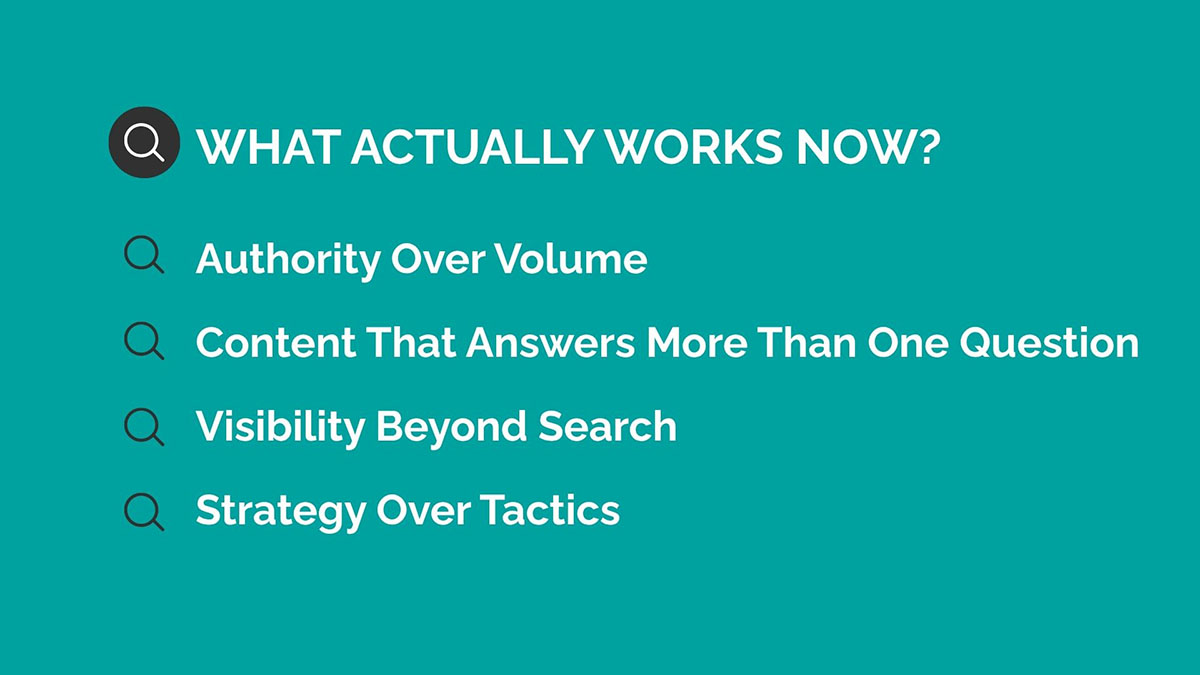
If the old playbook isn’t holding up and mass AI content isn’t the answer, what does work?
The shift isn’t about abandoning SEO. It’s about evolving it.
Here’s what’s making the difference right now.
Authority Over Volume
Publishing more content used to increase your chances of ranking.
Now, it often just increases your chances of being ignored.
Search engines are prioritizing signals of real authority. That includes expertise, brand presence, and consistency across channels. One strong, well-developed piece that demonstrates depth and credibility will outperform ten surface-level articles every time.
It’s not about how much you publish. It’s about how much trust you build.
Content That Answers More Than One Question
Users don’t think in single queries anymore, and your content shouldn’t either.
The pages that perform best now go beyond basic definitions or quick answers. They cover context, comparisons, use cases, and next steps. They anticipate what a user is going to ask next and answer it before they have to search again.
That depth is what makes content more likely to be surfaced in AI-driven results and keeps users engaged if they do click through.
Visibility Beyond Search
Google is still important, but it’s no longer the only place your brand needs to show up.
Search is being influenced by content across platforms. Video, social media, PR, partnerships, and even offline signals all contribute to how your brand is understood and trusted.
This is where more creative, human content starts to matter again.
Real voices. Real collaborations. Content that doesn’t feel like it was generated to fill space.
That kind of presence builds familiarity, and familiarity drives decisions.
Strategy Over Tactics
This is where a lot of businesses get stuck.
They’re still looking for the next tactic. The next hack. The next quick win.
But those don’t last in a landscape that’s changing this quickly.
What works now is a connected strategy. One that aligns SEO with brand, content, user experience, and conversion. One that looks at the full journey, not just where someone enters it.
Because traffic without direction doesn’t convert. And visibility without strategy doesn’t scale.
What to Do Next
If you’re trying to make sense of all of this, start simple.
Take a step back and look at your current strategy honestly.
- Are you creating content that actually answers real questions in depth, or just checking SEO boxes?
- Are you measuring success based on visibility and influence, or just traffic and rankings?
- Are you building a recognizable brand, or relying entirely on search to do the heavy lifting?
Because the gap between those two approaches is getting wider.
You don’t need to overhaul everything overnight. But you do need to adapt.
Start by focusing on quality over volume. Build content that reflects real expertise. Look beyond rankings and think about how your brand shows up across the entire search experience, including AI-driven results.
Most importantly, stop treating SEO as a standalone tactic. It’s no longer just about getting found. It’s about being trusted, referenced, and chosen.
The Bottom Line
But the version most businesses are still doing is fading fast.
Search has shifted from a list of links to a dynamic, AI-driven experience that prioritizes answers, context, and trust. The brands that win in this environment won’t be the ones producing the most content. They’ll be the ones who understand how people search now and build strategies that align with it.
Not sure if your SEO strategy is keeping up?
If you’re not sure where your current strategy stands, we’re happy to take a look.
No fluff. Just real insights into what’s working, what’s not, and where the opportunities are.