There’s a lot of noise out there about AI and what it means for marketing. Some people think it’s going to replace everything. Others are completely overwhelmed and don’t know where to start. The truth is, AI isn’t here to replace smart strategy or human creativity, but it is changing the game.
From tools like ChatGPT and Jasper to Google’s new Search Generative Experience, the way people search, interact with content, and make buying decisions is shifting. And fast.
As a marketer and SEO who’s been doing this for over 20 years, I’ve seen a lot of trends come and go. But AI is different. This is a foundational shift. If you want your brand to stay visible and competitive, now is the time to understand what AI-powered marketing really looks like and how to use it the right way.
What Is AI Marketing?
AI marketing is one of those terms that gets thrown around a lot, and like most buzzwords, it can mean a dozen different things depending on who’s using it. But here’s the bottom line: it’s about using artificial intelligence to streamline and scale your marketing efforts in a smarter, more personalized way.
This isn’t just automation. It’s not “set it and forget it” email flows. We’re talking about tools that can analyze behavior, predict outcomes, generate content, and make recommendations, all in real time. From writing ad copy and email sequences to segmenting audiences or testing subject lines, AI is helping marketers do more with less effort, and with better results.
That said, AI is only as good as the strategy behind it. If you’re relying on it without understanding your audience, your goals, or your funnel, it’s not going to magically fix anything. But in the hands of someone who knows how to build campaigns that convert? It’s a game changer.
What Is AI SEO?
Then vs. Now: SEO Strategy Comparison Chart
| SEO Element | Traditional SEO | AI SEO Today |
| Keyword Research | Manual, spreadsheet-heavy | Predictive, tool-assisted |
| Content Creation | Human-written, slow | AI-assisted, human-refined |
| Ranking Goals | Blue link in SERPs | Cited in AI results, featured |
| Structure | Keyword-centric | Semantic, structured, intent-driven |
| Tools | Google tools, SEMrush | ChatGPT, Surfer, Perplexity, Gemini |
Let’s be clear: AI isn’t replacing SEO, it’s reshaping how we do it.
AI SEO is about using smart tools and machine learning to help us do the heavy lifting. Instead of spending hours manually analyzing search results or building keyword lists from scratch, we can now lean on platforms like Surfer SEO, Clearscope, and ChatGPT to identify opportunities faster and with more precision.
That doesn’t mean you should let a bot write your content or define your strategy. What it does mean is that AI can assist with research, structure, optimization, and trend forecasting – and when paired with human insight and experience, it becomes a powerful tool.
It’s not magic. It’s not a shortcut. But it is the future of how we scale smarter, especially in a search landscape that’s changing faster than ever.
Understanding Large Language Models (LLMs)
If you’ve used ChatGPT, Gemini, or Claude, you’ve already interacted with a large language model, whether you knew it or not. These models are the engine behind most of the AI tools you see today. They’re trained on massive amounts of text and data so they can understand, generate, and respond to human language in ways that feel surprisingly natural.
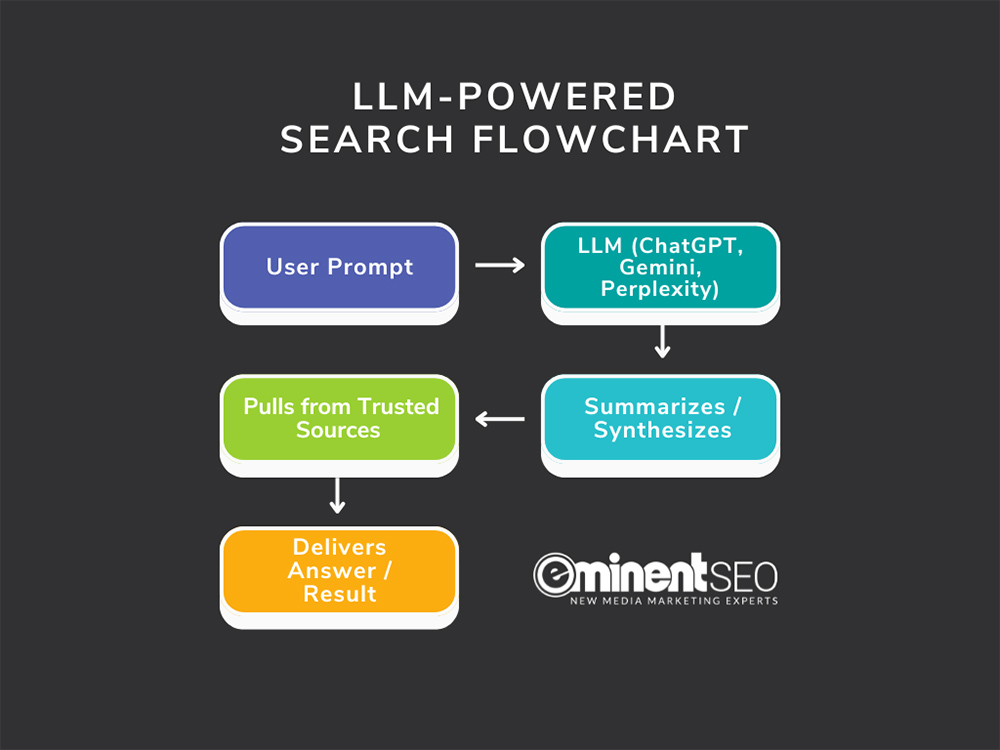
In practical terms, LLMs are what power AI-generated answers in tools like Google’s SGE, ChatGPT, and Perplexity. Instead of just pulling up links like a traditional search engine, these platforms summarize, explain, and deliver responses based on what they’ve “learned” from billions of data points.
For marketers and SEOs, this changes everything. If your content isn’t structured in a way that’s clear, trustworthy, and easy for AI to interpret, you could get skipped in favor of someone who has optimized for this new format. That’s why things like semantic relevance, structured data, and credible sourcing matter more than ever.
We’re not just optimizing for Google anymore. We’re optimizing for the way AI reads, understands, and serves content across platforms.
LLM-Powered Search Is Changing How People Find You
We’re not just seeing new platforms emerge, we’re watching the way people interact with search evolve right in front of us.
Instead of typing a few keywords into Google and sifting through results, users are asking full questions, giving instructions, and expecting instant, summarized answers. Whether it’s “write a quick pros and cons list” or “summarize this article,” AI tools are making micro-searches a part of everyday workflows.
That shift is especially true for younger users. Gen Z and Gen Alpha are growing up with AI built into their phones, browsers, and school tools. They don’t think about “search” the way older generations did. They just ask, and AI responds – instantly and conversationally.
For marketers, this means visibility isn’t just about ranking on page one anymore. You also need to consider how your content shows up in AI-driven answers on platforms like ChatGPT, Perplexity, Gemini, and even TikTok. That includes everything from how well your content is structured to whether it’s being referenced as a trusted source.
This is where generative engine optimization, or GEO, starts to matter. We’ll get into that next, but the key takeaway is this: the rules of visibility are changing. And the brands that adapt will have a serious advantage.
For a deeper dive into how AI is already shifting visibility and what that means for your rankings, take a look at Adapting Your SEO Strategy for AI-Driven Search.
Popular Terms in the AI SEO and Marketing Space
There’s no shortage of buzzwords in the AI space. Some are helpful. Some are hype. Here’s a breakdown of the most common terms you’ll hear, and what they actually mean in a real-world marketing context.
| Term | Meaning / Use Case | Notes |
| AI-Powered SEO | AI tools assist in SEO tasks | Most common industry term |
| Programmatic SEO | Automated large-scale content generation | Good for location/service pages |
| Generative SEO | SEO using AI-generated content | Often overlaps with LLM use |
| GEO (Generative Engine Optimization) | Optimizing for AI-generated answers | Still emerging, high interest |
| SGE SEO | Optimizing for Google’s Search Generative Experience | Becoming critical for visibility |
| AI Content Marketing | AI use across blog, email, ads | Broader than SEO alone |
| AIO (AI Optimization) | Optimizing specifically for AI tools like ChatGPT | Niche, rising |
AI-Powered SEO / AI-Driven SEO
These are the most widely accepted terms. They refer to using artificial intelligence tools to assist with keyword research, content optimization, SERP analysis, and on-page structure. Tools like SurferSEO, Clearscope, and MarketMuse fall into this category.
Programmatic SEO
This involves using automation to create large volumes of SEO-optimized content. Think location-based pages, product variations, or service bundles that follow a template. Often used by enterprise sites, but gaining traction as AI tools make content generation more scalable.
Generative SEO
A newer term focused on AI-generated content and how it performs in search. This is tied closely to tools like ChatGPT and Jasper. The key is making sure content is structured, human-reviewed, and strategically aligned, not just auto-generated to fill space.
AI Content Marketing
A broader umbrella that includes AI-assisted writing for blogs, emails, social posts, ad copy, and more. It’s not just about SEO, but about supporting the entire customer journey through AI-enhanced content.
Search Engine AI / SGE SEO
Refers to optimizing for AI-generated search results, like Google’s Search Generative Experience. It’s still evolving, but the focus is on being cited, summarized, or sourced in AI-driven answers rather than just being listed in blue links.
AI-First Marketing
This describes a full-stack approach where AI tools are used at every stage – research, strategy, content creation, targeting, and performance tracking. It’s becoming more common for brands that want to scale quickly without growing their team too fast.
Other AI Marketing Buzzwords You Might Hear
- AutoSEO: Used by some tools that promise one-click SEO fixes. These usually oversimplify complex tasks.
- Neural SEO: A flashy term with no consistent definition. Use with caution.
- AIO (AI Optimization): Refers to optimizing content specifically for AI engines like ChatGPT and Gemini.
- GEO (Generative Engine Optimization): The practice of structuring and writing content so it gets picked up by AI-driven search tools.
What Should Businesses Do About All This?
First, don’t panic. You don’t need to overhaul your entire strategy overnight. But you do need to start looking at your content, your SEO, and your marketing through a new lens.
If your brand relies on visibility, you need to think beyond traditional rankings. It’s not just about being on page one of Google anymore. It’s about being referenced, summarized, or suggested by AI tools that are becoming the new layer of search.
Start by reviewing how your site is structured. Is your content clear, well-organized, and easy for machines to understand? Are you using schema markup? Are you answering real questions people ask, not just stuffing keywords into paragraphs?
From there, look at where AI can help you move faster or smarter. Use tools to speed up research, test ideas, generate outlines, or repurpose content across channels. But always pair those tools with strategy and human review.
This is not the time to blindly automate. It’s the time to get sharper and more efficient – with tools that support your goals, not replace your judgment.
If you’re looking for a smart, strategic approach to AI-powered optimization, check out our AI SEO & Marketing services to see how we’re helping brands adapt and scale.
And if you want to see where all of this is headed, don’t miss our latest insights on Marketing for 2025 – it’s a roadmap for brands preparing for what’s next in search, content, and user behavior.
How to Optimize for ChatGPT, Perplexity, and Google SGE
If you want your brand to show up in AI-powered search results, you need to think differently about how your content is created, structured, and presented. These platforms are not just crawling pages and matching keywords – they’re analyzing context, credibility, and clarity.
Here’s what actually helps:
1. Be Clear, Not Clever
LLMs like ChatGPT pull from well-structured, easy-to-understand content. That means plain language, strong headings, and direct answers. This isn’t the place for jargon or long-winded intros.
2. Answer Questions Directly
Think about the kinds of prompts users type into AI tools. Things like “What is programmatic SEO?” or “How do I improve local visibility?” Create content that answers those types of questions clearly and concisely.
3. Use Schema Markup
Structured data helps AI tools interpret your content with more confidence. It’s one of the best ways to support featured snippets, rich results, and inclusion in SGE-style summaries.
4. Prioritize Source Quality
If you want AI tools to cite you, your content needs to be trustworthy. That includes referencing credible sources, using original insights or data when possible, and building domain authority over time.
5. Update and Maintain Evergreen Content
AI tools are less likely to pull from outdated or stale content. Regularly refresh your top-performing pieces and make sure your information reflects current trends and standards.
6. Think Platform by Platform
ChatGPT and Gemini are trained differently than Google SGE or Perplexity. While you can’t “optimize” for them the way you do for a traditional search engine, you can create content that increases your odds of being included across all of them – clean, useful, well-cited, and genuinely helpful.
Explore our AI SEO & Marketing Services
Final Thoughts: AI Isn’t Replacing SEO, It’s Redefining It
AI is already changing how people search, what they expect from content, and which brands show up first. This shift isn’t coming, it’s already here. And the businesses that adapt early are going to have a serious edge.
But let’s be honest. This isn’t about chasing shiny tools or jumping on every trend. It’s about making smart decisions. The brands that will win are the ones who combine real strategy with the right AI support. Not shortcuts. Not fluff. Just sharper execution and better use of time and resources.
If you’re thinking bigger – not just about your SEO, but your entire approach – we also cover what this shift means in It’s Time for a Digital Marketing Reset. It’s a broader look at how marketing is changing and why now is the time to rethink the way your brand shows up.
If you’re not sure where to start, that’s okay. Start with a conversation. Get an audit. Ask the right questions. We’re already helping clients figure out how to make sense of AI in a way that’s strategic, ethical, and actually useful.
Want to know how your brand shows up in AI-generated results?
Let’s talk about what’s working, what’s missing, and where you can go from here.