
Every year, certain dates show up on the calendar and brands suddenly find their voice. A quote. A graphic. A statement of solidarity. Then the moment passes, and so does the messaging.
Consumers are smarter than we give them credit for. They can tell the difference between a company that integrates its values into daily operations and one that checks a calendar box.
And the cost of getting that wrong isn’t backlash. It’s credibility.
Authentic Brand Values Show Up Year-Round
They show up in hiring decisions. In partnerships. In the vendors you choose. In the imagery you use. In the language on your website. In who you feature in your case studies. In who feels welcome when they land on your homepage.
High-performing marketing teams don’t scramble for relevance when a date appears on the calendar. They build brands that reflect their values every single day.
When every cultural moment becomes a campaign, your core message starts to blur. Instead of strengthening trust, you dilute it.
And dilution is expensive.
Advocate vs. Performance Artist
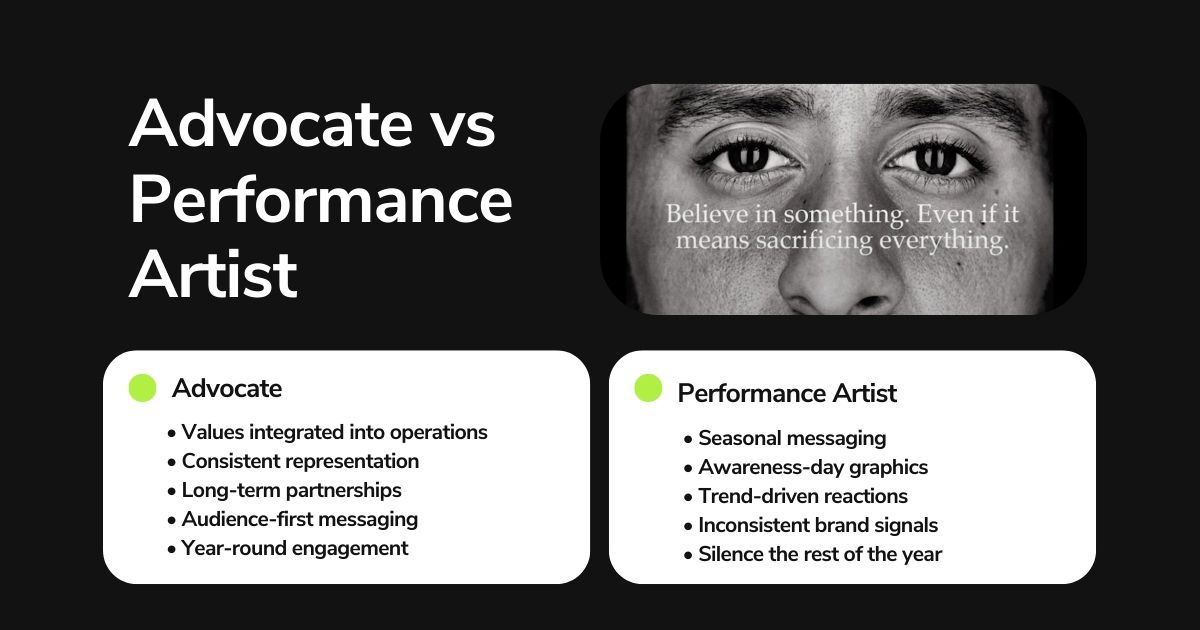
The difference between advocacy and performance comes down to consistency.
Advocates integrate their values into how they operate. It shows up in the products they create, the people they hire, the partnerships they pursue, and the communities they support. Their messaging reflects something that already exists inside the organization.
Performance artists take a different approach. They show up when the calendar tells them to. A graphic. A quote. A carefully worded post. Then the moment passes and the brand returns to business as usual.
Audiences can tell the difference.
For people who live these experiences every day, visibility isn’t seasonal. It’s not a campaign. It’s part of daily life. When brands only acknowledge those realities once a year, the effort can feel less like support and more like a marketing exercise.
And in an environment where trust is one of the most valuable assets a brand can build, that distinction matters.
Why Performative Marketing Happens
To be fair, most brands don’t set out to be performative.
Marketing teams operate in fast-moving environments where cultural moments appear quickly and expectations to respond can feel immediate. A trending topic appears. Competitors post. Social media fills with statements. Suddenly the pressure to say something feels urgent.
In those moments, the safest decision often feels like participation.
But urgency rarely leads to thoughtful strategy.
When brands respond without the underlying structure to support the message, policies, partnerships, representation, or long-term initiatives, the result is messaging that feels disconnected from the rest of the brand experience.
And audiences pick up on that disconnect quickly.
The issue isn’t participation. It’s alignment.
When messaging reflects real internal values and actions, audiences recognize it. When it doesn’t, it reads as marketing.
Brands That Mean It (And Brands That Don’t)
The difference becomes obvious when you look at brands that have built their identity around real advocacy.
Take Ben & Jerry’s.

Love them or hate them, their stance on social issues isn’t seasonal. It’s part of their brand DNA. They fund initiatives. They publish policy positions. They use their platform consistently, not just when a holiday rolls around or when a trending hashtag appears.
You may not agree with every position they take, but you rarely question whether they believe it.
That consistency matters.
Because when a brand only shows up during a cultural moment with a polished graphic and a quote, but the rest of the year their messaging, leadership, partnerships, and products tell a different story, audiences notice.
And today’s audiences are paying attention.
They look at who you hire.
Who you feature.
Who your products are made for.
Who feels seen when they interact with your brand.
A single post can’t carry that weight.
For Some Communities, Visibility Isn’t Seasonal
Recently, my niece Casey and I have been collaborating on one of our creative projects at Eminent, NamaSlay Crew. It’s a brand focused on wellness, community, and self-expression.
While planning upcoming content, we were talking about whether we should post something specifically for Trans Day of Visibility. Casey’s response stuck with me.
For her, visibility isn’t a single day on the calendar. It’s every day.
That perspective highlights something many brands miss. For the communities represented during awareness months or recognition days, these aren’t temporary conversations. They’re lived experiences.
So when brands show up once a year with a message of support and then disappear from the conversation entirely, it can feel less like advocacy and more like participation in a marketing moment.
Real inclusion doesn’t only appear in March, February, or June. It shows up in who you feature in your imagery, who your products are designed for, who sits at the decision-making table, and whose voices are part of the conversation year-round.
That’s what audiences recognize as authentic.
And authenticity is what builds trust.
It’s Also Just Good Business
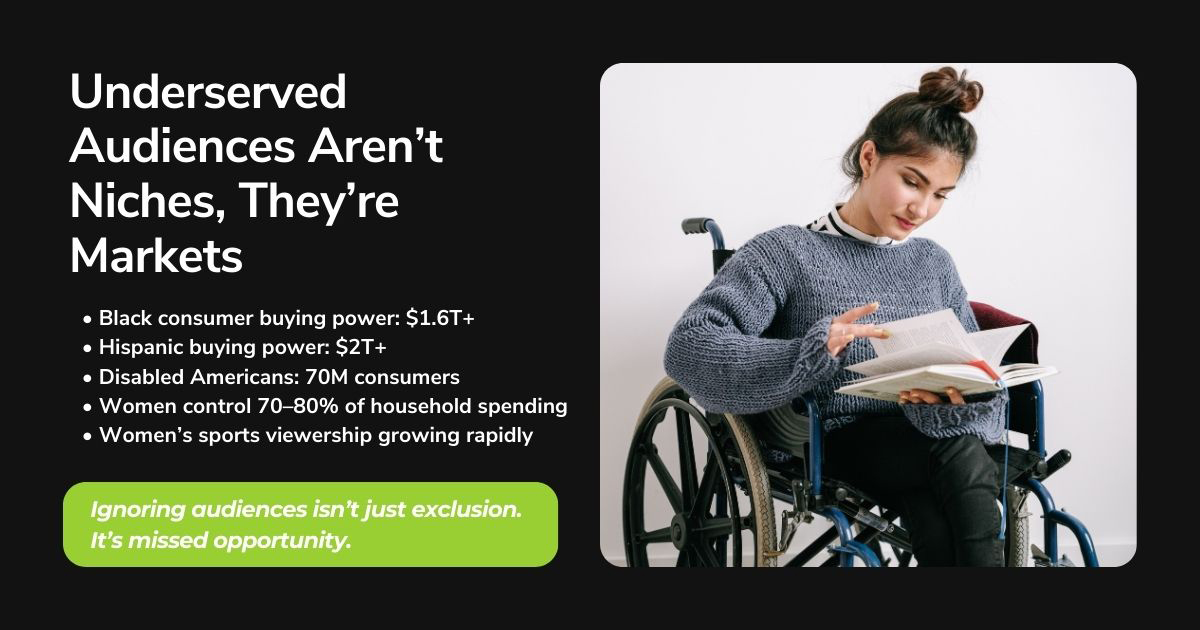
There’s another reason this matters. It’s not just about values. It’s about markets.
Some of the most successful brands in the world have grown by recognizing communities that were previously overlooked or underserved.
For years, beauty companies largely ignored products designed specifically for Black women. When brands finally began creating products that truly served that audience, the result wasn’t just cultural impact. It created billion-dollar categories.
Fenty Beauty built a billion-dollar cosmetics line by recognizing that many skin tones had been ignored by traditional beauty brands for decades and designing products specifically for those underserved consumers.

The same thing has happened across other industries. Women’s sports, once dismissed as a niche, are now seeing explosive growth in viewership, sponsorships, and merchandise sales.
Spanish-speaking audiences represent tens of millions of consumers in the United States alone. People with disabilities represent one of the largest and most overlooked consumer groups in the country.
These communities aren’t “segments.” They’re markets.
And they buy things.
The brands that recognize this don’t wait for a specific awareness month to acknowledge their audiences. They build products, messaging, and experiences designed to serve real people year-round.
Because when your brand truly understands its audience, inclusion isn’t a campaign. It’s strategy.
What Authentic Brands Do Differently
Brands that build long-term trust approach these moments differently.
Instead of reacting to the calendar, they build systems that naturally reflect their values.
That might include:
- Diverse representation in everyday marketing imagery
- Partnerships with organizations that support their communities
- Products designed with underserved audiences in mind
- Leadership teams that reflect the audiences they serve
- Messaging that shows up consistently throughout the year
When those things exist, a post during an awareness month doesn’t feel performative. It feels like a natural extension of the brand.
The marketing isn’t the signal.
It’s simply the reflection of work that’s already happening.
How Brands Can Avoid the Performative Trap
So how do brands avoid falling into performative marketing?
It starts by shifting the focus away from moments and toward systems.
Instead of asking “What should we post for this day?” strong marketing teams ask a different set of questions:
- Who are we actually serving with our products and services?
- Are those audiences reflected in our messaging and imagery?
- Are we building relationships with the communities we say we support?
- Do our hiring, partnerships, and collaborations reflect the values we talk about publicly?
When those foundations are in place, participating in cultural moments doesn’t feel forced. It feels natural.
The message is no longer a reaction to a trending topic or a date on the calendar. It’s simply a reflection of the work the brand is already doing.
And that’s the difference audiences recognize immediately.
Consistency Builds Trust
Marketing works best when it reflects something real.
Audiences today are paying attention to more than just what brands say. They’re watching what brands do, who they include, and whether their values show up consistently over time.
Posting once a year about an issue that matters to your audience isn’t inherently wrong. But when it’s the only time those values appear, it starts to look less like commitment and more like participation in a moment.
Strong brands don’t chase moments. They build relationships.
They understand who their audience is, what matters to them, and how their products, messaging, and actions can serve that audience in meaningful ways throughout the year.
In 2026, trust isn’t built through the loudest campaigns or the most polished graphics.
It’s built through consistency.
Because the brands that win aren’t the ones that show up once a year.
They’re the ones that show up every day.