Search visibility is changing again, and this time it is not just about rankings. Google’s AI Overviews, Preferred Sources, brand signals, reviews, citations, and user behavior are all pointing toward a bigger shift:
Businesses need to become trusted sources, not just optimized websites.
In this article, we’ll look at what this shift means for SEO, why trust and authority are becoming more important in AI-powered search, and what businesses can do now to build visibility that lasts.
Search Is No Longer Just About Rankings
For most of SEO’s history, success was relatively straightforward. If you ranked well for the right keywords, you had a good chance of attracting traffic, generating leads, and growing your business. While there have always been other factors at play, rankings were often the primary measure of visibility.
Today, the search landscape looks very different.
Users can discover information through AI Overviews, featured snippets, local listings, videos, social content, discussion forums, and AI-generated answers before ever clicking through to a website. In many cases, searchers get the information they need without following the traditional path from search result to webpage.
That doesn’t mean rankings no longer matter. They absolutely do. Strong SEO fundamentals remain essential for helping search engines understand your content and connect it with the right audience.
What has changed is that rankings are now just one visibility signal among many.
A business can be mentioned in an AI-generated answer, referenced in a forum discussion, cited by an industry publication, or discovered through a trusted recommendation. The companies that earn attention across multiple channels are often building authority that extends beyond their position in search results.
As marketers, this requires us to think differently. Instead of focusing solely on where a page ranks, we need to think about how our brands, expertise, and content are being discovered throughout the entire search ecosystem.
This evolution didn’t happen overnight. Search has been moving in this direction for years through algorithm updates, changes in user behavior, mobile-first experiences, E-E-A-T, and now AI-powered search. If you’d like a look at how these changes have unfolded over time, explore our Evolution of SEO timeline.
Why Google’s Preferred Sources Feature Matters
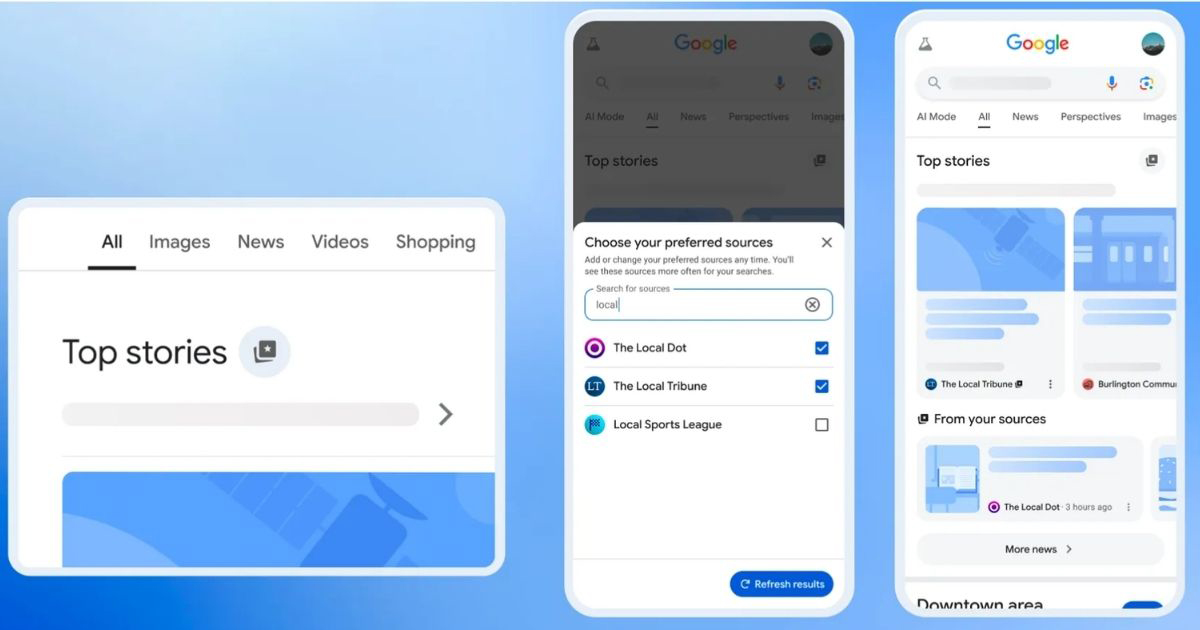
Google’s Preferred Sources feature allows users to identify publishers and websites they trust, adding another layer to how information may be surfaced in AI-powered search experiences.
One recent announcement that caught my attention wasn’t a major algorithm update or another AI feature. It was Google’s expansion of Preferred Sources.
At first glance, it may seem like a relatively minor change. Users can now identify publishers and websites they trust, helping Google personalize certain search experiences and highlight preferred content sources.
What interests me isn’t the feature itself. It’s what the feature represents.
For years, Google’s job has been to determine which pages deserve to rank for a given search query. Preferred Sources introduces another layer to that process by acknowledging that users have opinions too. They have creators, publications, businesses, and brands they trust, and they want to see more content from those sources.
If you think about your own behavior online, this makes perfect sense. Most of us don’t evaluate every source from scratch every time we need information. We return to the people, websites, and organizations that have consistently provided useful, accurate, or insightful content in the past.
That’s why I think this announcement is bigger than it appears.
Google announced the change alongside broader efforts to surface more original, high-quality content and diverse perspectives from sources across the web, including discussions, forums, and social content.
It signals a growing emphasis on recognition and trust. Not just whether your content exists, but whether your audience knows who you are, values your expertise, and actively seeks out your perspective.
In many ways, this is a natural evolution of search. Google has always been trying to identify the most helpful and trustworthy information available. Features like Preferred Sources simply bring the human element of trust into the equation more directly.
For businesses and marketers, the takeaway is clear:
Creating content is important, but becoming a recognized source of information may be even more valuable.
The Problem With Commodity Content
If you’ve spent any time online lately, you’ve probably noticed that a lot of content is starting to sound the same.
Part of that is because AI has made content creation faster and easier than ever before. Businesses can publish more content, cover more topics, and produce articles at a scale that wasn’t possible just a few years ago.
The problem is that volume alone doesn’t create value.
When dozens or hundreds of websites are publishing articles that cover the same points, reference the same sources, and arrive at the same conclusions, it becomes increasingly difficult for any one piece of content to stand out.
If everyone is saying essentially the same thing, why should Google surface one article over another?
This is also where brands can lose trust. When marketing starts to feel performative, repetitive, or disconnected from real expertise, audiences notice.
That’s where the concept of “commodity content” comes in.
Commodity content is content that can easily be replicated. It may be factually correct, well organized, and even optimized for search, but it doesn’t offer anything particularly unique. It doesn’t provide new insights, real-world experience, original research, or a perspective that moves the conversation forward.
Some common examples include:
- Rewritten versions of competitor articles
- Generic AI-generated summaries
- Surface-level how-to guides
- Content created solely to target keywords
- Articles that repeat information already widely available online
The reality is that AI can generate this type of content extremely well. If the primary value of an article is summarizing information that already exists, it becomes much easier for search engines and AI systems to bypass it altogether.
That’s why I think we’re seeing Google place greater emphasis on expertise, experience, and original perspectives. In Google’s guidance for AI-powered search experiences, the company encourages creators to focus on unique value and content that provides something beyond information already widely available online. The content that stands out today often includes something that can’t easily be replicated, whether that’s firsthand knowledge, a unique point of view, proprietary data, case studies, or lessons learned from actual experience.
In other words, the goal is no longer just to create content.
The goal is to create content worth remembering.
As businesses continue to invest in SEO and content marketing, I believe the brands that win will be the ones that contribute something meaningful to the conversation rather than simply adding to the noise.
The Growing Importance of Brand Signals
If search engines and AI systems are increasingly trying to identify trusted sources, then the next question becomes: how do they determine who deserves that trust?
The answer isn’t a single ranking factor. It’s a collection of signals that help establish credibility, authority, and recognition across the web.
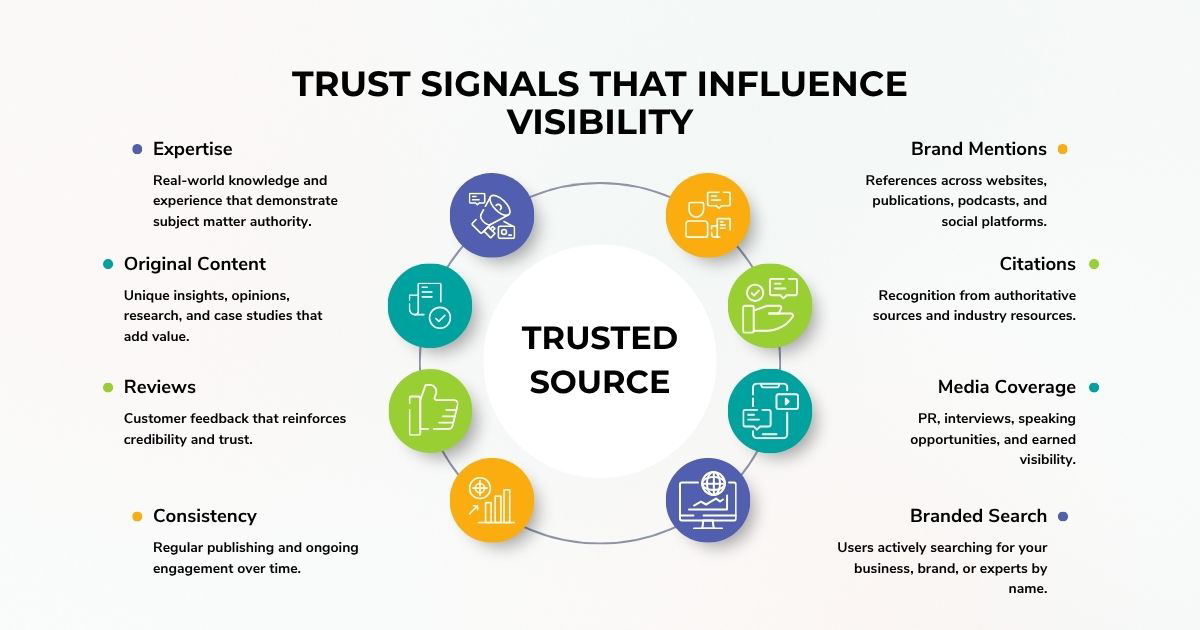
This is where brand signals become increasingly important.
For years, SEO conversations focused heavily on backlinks. While links still matter, Google has become much better at understanding brands, entities, and relationships. A business doesn’t build authority through links alone. It builds authority through its reputation, visibility, expertise, and the way people talk about it online.
Some of the trust signals that can contribute to online visibility include:
- Positive reviews and ratings
- Brand mentions across websites and publications
- Citations in industry resources
- Expert quotes and thought leadership
- Media coverage and digital PR
- Consistent business information across platforms
- Branded searches and direct traffic
- Engagement from a loyal audience
Individually, these signals may seem unrelated. Together, they help paint a picture of who you are and whether your business is recognized as a credible source of information.
This isn’t entirely new. Local SEO has relied on trust signals for years. Reviews, business listings, and reputation management have always influenced visibility. What’s changing is that we’re seeing similar concepts play a larger role across the broader search ecosystem.
Think about how AI-generated answers are created. They don’t simply rank webpages. They pull information from multiple sources, identify patterns, and attempt to surface information that appears reliable and helpful. Businesses that are consistently cited, referenced, reviewed, and discussed have a greater opportunity to become part of that conversation.
This is one of the reasons I’ve been encouraging clients to think beyond rankings alone. Strong SEO is still essential, but visibility today is often the result of multiple marketing efforts working together. Content marketing, public relations, reputation management, social proof, branding, and SEO all contribute to building authority over time.
The brands that consistently show up, provide value, and earn trust are often the brands that continue gaining visibility, regardless of how search technology evolves.
What Businesses Should Be Doing Right Now
The good news is that most of the things businesses should be doing today aren’t radically different from what they’ve always needed to do. The difference is that the companies treating SEO as part of a larger visibility strategy are likely to have an advantage over those focused solely on rankings.
If I were advising a business on how to improve visibility in today’s search environment, I’d focus on five key areas.
1. Invest in Real Expertise
One of the easiest ways to stand out is to share knowledge that comes from actual experience.
Whether you’re an attorney, healthcare provider, contractor, consultant, or business owner, you have insights that competitors and AI tools can’t easily replicate. Share what you’ve learned, answer common questions, discuss industry trends, and provide perspectives that come from doing the work, not just researching it.
2. Create Original Content
Not every piece of content needs to be groundbreaking, but it should add something to the conversation.
That could be:
- Case studies
- Proprietary research
- Industry observations
- Client success stories
- Lessons learned
- Expert opinions
If your content could be copied, rewritten, and published by anyone else with minimal effort, it’s going to be increasingly difficult to stand out.
3. Build a Recognizable Brand
One of the biggest shifts I’m seeing is the growing importance of recognition.
People trust brands they know. They click on names they’ve seen before. They engage with companies that consistently show up and provide value.
That’s why branding, public relations, content marketing, social media, email marketing, and SEO all work best when they’re aligned. The goal isn’t simply to generate traffic. It’s to become memorable.
4. Earn Mentions, Citations, and Reviews
Visibility doesn’t happen exclusively on your website.
Reviews, industry citations, media mentions, podcast appearances, guest articles, partnerships, and community involvement all contribute to how your business is perceived online.
The more often your expertise is referenced by others, the stronger your authority signals become.
5. Focus on Trust, Not Just Traffic
This is probably the biggest mindset shift.
For years, marketers have chased traffic as the primary goal. While traffic remains important, trust is what ultimately drives conversions, referrals, and long-term growth.
A smaller audience that trusts your expertise can be far more valuable than a large audience with no connection to your brand.
Businesses that prioritize trust tend to build stronger customer relationships, generate more referrals, and create content that continues delivering value long after it’s published.
The Future Belongs to Trusted Sources
After more than 20 years in SEO, I’ve learned that Google rarely changes what it’s trying to accomplish. What changes is how it measures success.
We’ve seen that evolution play out through backlinks, content quality, mobile optimization, user experience, E-E-A-T, reviews, and now AI-powered search experiences. The tactics and technologies continue to evolve, but the underlying goal remains surprisingly consistent: connect people with the most helpful, relevant, and trustworthy information available.
That’s why I think the recent conversations around AI search, Preferred Sources, authority signals, and content quality are so important. They aren’t isolated developments. They’re all pointing toward a broader shift in how visibility is earned online.
Businesses that continue focusing exclusively on rankings may still find success. Rankings aren’t going away. But the organizations that build expertise, develop a recognizable brand, earn trust, and contribute something meaningful to their industry will likely have an advantage as search continues to evolve.
In many ways, this is good news.
The businesses that have invested in their reputation, shared their expertise, built relationships with their audiences, and consistently provided value are finally seeing those efforts reflected in more places than just traditional search results.
My advice is simple: continue investing in SEO and AIO, but don’t stop there. Build a brand people recognize. Share insights that come from real experience. Earn reviews, citations, and mentions. Create content that contributes something new to the conversation.
Because in a world where anyone can generate content, trust may become one of the most valuable assets your business can have.
Sources:
- Google. (n.d.). Optimizing for AI features in Google Search. Google Search Central. Retrieved June 17, 2026, from https://developers.google.com/search/docs/appearance/ai-features
- Google. (n.d.). Preferred sources in Google Search. Google Search Central. Retrieved June 17, 2026, from https://developers.google.com/search/docs/appearance/preferred-sources
- Google. (2026, May 20). Helping people discover original, high-quality content in Search. Google. https://blog.google/products-and-platforms/products/search/original-high-quality-content-search/