Businesses come to us all the time knowing they need something, but not necessarily knowing what that something is.
“We need better SEO.”
“We need more leads.”
“We should probably be doing more social media.”
“Our website needs help.”
“Should we be optimizing for AI?”
Sometimes the answer is yes. But after more than 20 years of doing this work, I’ve learned that the thing a business asks for is not always the thing that will actually solve the problem.
You can send more traffic to a website, but that does not help much if nobody understands the offer once they get there. You can generate more leads, but that will not fix a sales process where inquiries sit unanswered for two days. You can publish more content, run more ads, and add more marketing channels, but if you have not figured out where people are getting stuck, you may just be putting more money into the same broken system.
That is why one of the first questions we ask is also one of the simplest:
What problem are we actually trying to solve?
“The fastest way to waste a marketing budget is to solve the wrong problem.” – Jenny Weatherall
Start With What Is Actually Happening
Marketing conversations have a tendency to begin with channels. SEO. Google Ads. Instagram. Email. Video. AI search.
I would rather start with the business.
What is happening now? Where do customers come from? What happens when they find you? Where are you losing them? What are your strongest leads doing differently from everybody else? Are people finding you and not converting, or are they simply not finding you in the first place?
Those questions sound basic, but they change the strategy completely.
For example, if people are actively searching for what you sell and your competitors continually appear while you do not, that may legitimately be an SEO or visibility problem. That is where a proper SEO audit and strategy can uncover technical issues, content gaps, missed search opportunities, and other reasons you are not being found.
But imagine that organic traffic is already healthy. People are landing on the website. Your Google Business Profile generates calls. Paid campaigns are producing clicks.
Now we have a different problem.
Adding another traffic source is probably not the first thing I would recommend.
Google has spent years studying the increasingly complicated path people take before making a purchase. Its “messy middle” research describes a customer journey where people move through repeated periods of exploration and evaluation rather than following a neat funnel from awareness to purchase.
That matches what we see in practice. Someone may find you on Google, leave, read reviews, ask ChatGPT a question, look at a competitor, see one of your social posts, return to your website three days later, and finally call.
Marketing does not happen in one little box anymore.
Figure Out Where People Are Getting Stuck
One of the most useful things you can do is stop looking at marketing as a collection of tactics and look at the experience from the customer’s point of view.
Can they find you?
When they do, do they understand you?
Do they believe you?
Can they easily do what you want them to do next?
And once they become a lead or customer, does the experience live up to what the marketing promised?
That is the real funnel.
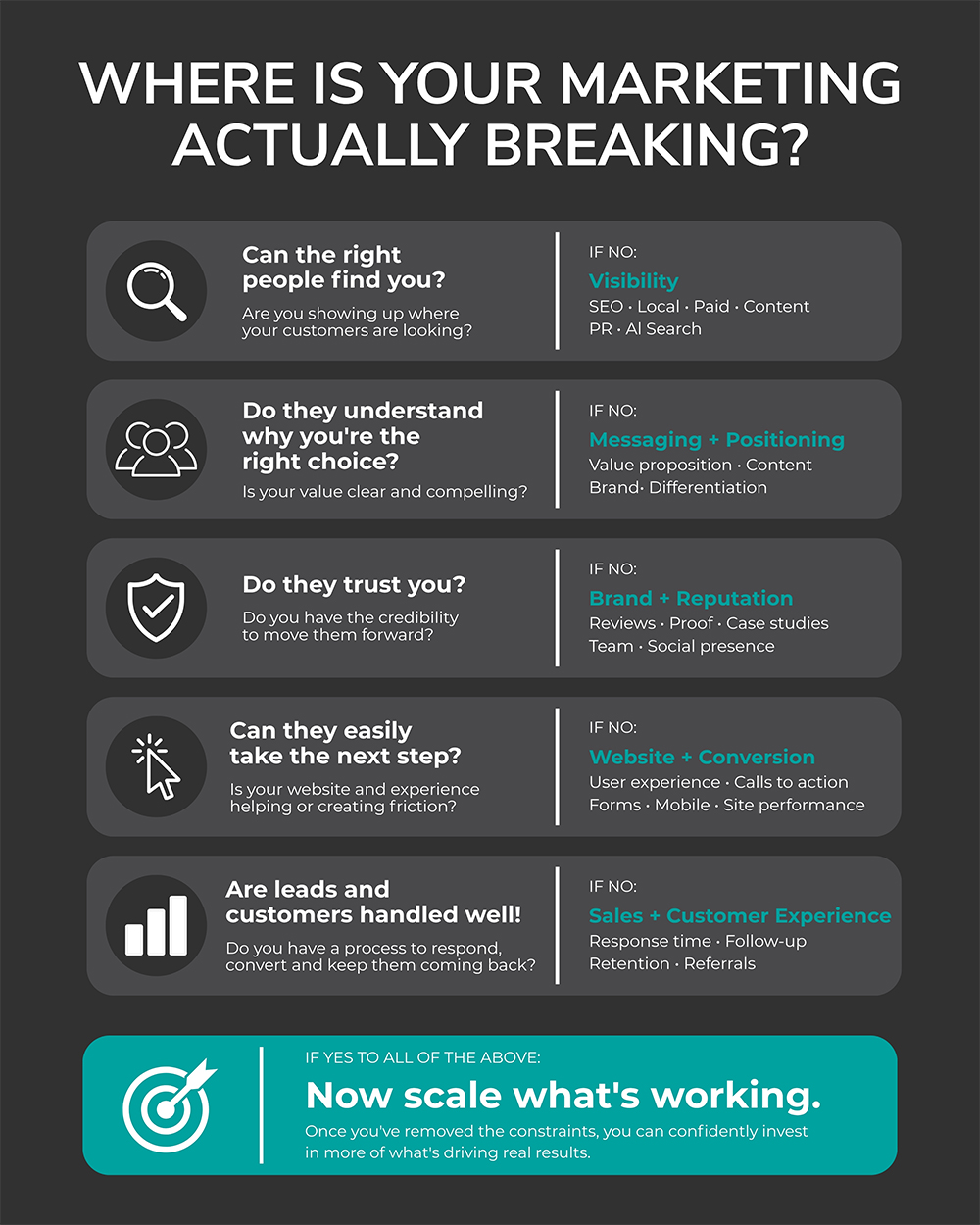
This is where marketing gets much easier to diagnose.
If people cannot find you, we need to look at search visibility, local presence, advertising, content, referrals, and increasingly AI search visibility.
If they find you but do not understand why they should choose you, we may have a messaging or positioning problem. This happens more than businesses realize, particularly when a company has added services over time, and the website has slowly turned into a collection of everything the company can do instead of a clear explanation of why anyone should care.
If people understand you but are hesitant to make contact, look at trust. Reviews, reputation, your team, examples of your work, third-party validation, your social presence, and the overall quality of the brand all contribute to that decision. Our reputation management work often begins by looking at the entire digital footprint because customers do the same thing.
And then there is the website itself.
A website can rank beautifully and still be bad at selling. It can look beautiful and still be frustrating to use. Sometimes something as simple as confusing navigation, a weak call to action, an unnecessarily long form, or missing information is creating friction.
Google’s own research on landing-page decision-making has found that reducing friction and helping people feel confident about their choices can materially affect the buying experience. (Google)
That is also why we do not think about website design and development as decoration. Design, messaging, user experience, SEO, and conversion all have to work together.
“More traffic to a broken experience just creates more people who don’t convert.”
— Jenny Weatherall
Sometimes the Marketing Is Working
This is the part nobody loves to hear.
Sometimes marketing is doing exactly what it is supposed to do, and the actual problem happens after the lead comes in.
A campaign might generate 50 inquiries. That sounds great until you discover that only 30 were contacted, the average response time was more than a day, nobody followed up with people who did not answer the first call, and there is no system for distinguishing qualified prospects from junk.
At that point, are the leads bad?
Maybe.
But we do not know yet.
Before buying another 50 leads, I want to know what happened to the first 50.
This is one reason we talk so much about the buyer’s journey. From the customer’s perspective, filling out the contact form is not the end of the marketing experience. The phone call, email response, appointment process, sales conversation, and follow-up are all part of what that person experiences with your brand.
The same thing happens after the sale.
Companies can become so focused on attracting new customers that they barely communicate with the customers they already paid to acquire. There is no useful follow-up, no email strategy, no review request, no referral process, and no real reason to stay connected.
Then everyone goes back to marketing and asks for more leads.
Sometimes that is necessary. Sometimes the better opportunity is sitting right in front of you.
More Marketing Is Not Always the Answer
There is enormous pressure right now to be everywhere.
You need SEO. And social. And video. And paid search. And email. And now you had better show up in ChatGPT too.
I understand why businesses feel behind.
But adding another channel just because it exists is not a strategy.
We work across SEO, content, websites, brand, paid media, social, email, local marketing, reputation, and creative, and I actually think that makes it more important for us not to prescribe everything to everybody.
The value of having more tools is being able to choose the right one.
If the website is the problem, fix the website.
If your positioning is muddy, fix the messaging.
If nobody can find you, work on visibility.
If you have traffic but no leads, investigate conversion.
If leads are coming in but nobody is closing them, look beyond marketing.
If customers love you but never hear from you again, work on retention.
It sounds obvious written out like that. It is much less obvious when you are inside the business, and every vendor is telling you that their service is the missing piece.
A Good Marketing Audit Should Tell You What to Do Next
This is also why I believe so strongly in starting with an audit.
Not because businesses need another 80-page PDF full of charts they will never look at again.
A useful marketing audit should help answer something much more practical:
Where is the biggest opportunity right now?
Sometimes that means uncovering technical SEO problems. Sometimes we find pages sitting just outside page one that are much easier to improve than starting a completely new content strategy. Sometimes the website structure is a mess. Sometimes we discover that a business is getting plenty of visibility but sending everyone to weak landing pages. Sometimes the marketing is fragmented across five different vendors with nobody looking at the whole picture.
Our audit and strategy process is designed around that bigger view. We want to understand the website, search presence, competitors, content, user experience, tracking, and marketing ecosystem before deciding what deserves the most attention.
Because the answer should not automatically be “do more.”
Sometimes the smartest thing you can do is fix what you already have.
Ask a Better Question
After doing this work for more than two decades, I still get excited about new tools and new ways to reach people. Search has changed dramatically. Websites have changed. Social media changed marketing. AI is changing it again.
But none of that has changed this part.
You have to understand the problem before you can build the strategy.
So if your marketing feels stuck, I would not start by asking whether you should spend more on SEO, launch another ad campaign, or start posting five times a week.
Start here:
Where are people getting stuck?
Once you know that, deciding what to do next becomes a whole lot easier.
Let’s figure out what actually deserves your attention first.