In This Article, You’ll Learn:
- Whether Google penalizes AI-generated content
- What Google considers scaled content abuse
- When AI-generated content can become an SEO risk
- How to audit AI content already on your website
- What to check if your traffic drops after a Google spam update
- How to use AI for content without sacrificing quality
- Why original content matters even more in AI-powered search
AI has made it possible to create more content, faster, and at a fraction of what it used to cost.
Sounds great, right?
It can be. We use AI ourselves, and we believe it can be an incredibly valuable tool for research, ideation, analysis, content development, and marketing efficiency.
But there’s a big difference between using AI to create better content and using AI simply to create more content.
And as AI continues to change the rules of search, Google is making that distinction increasingly important.
With Google’s August 2026 spam update now rolling out, businesses are once again asking whether AI-generated content could hurt their rankings. It’s a fair question, especially for companies that have spent the last few years adding AI-assisted blogs, landing pages, FAQs, location pages, product descriptions, and other content to their websites.
The short answer?
AI content itself isn’t the problem. Low-value content created primarily to manipulate search visibility is.
And with AI making that kind of content easier to produce at scale, now is a very good time to look at what’s actually on your website.
Does Google Penalize AI-Generated Content
No. Google does not automatically penalize content because AI was used to create it.
Google’s guidance has remained fairly consistent on this point. Its ranking systems are intended to reward original, useful, high-quality content regardless of how it was produced. In fact, Google’s guidance on using generative AI content acknowledges that AI can be useful for research and adding structure to original content.
Google even acknowledges that generative AI can be useful for things like research and adding structure to original content.
Where things get risky is when automation is used primarily to manipulate search rankings.
Google specifically warns against using generative AI or other tools to produce large numbers of pages without adding meaningful value for users. That can violate its policy against what it calls scaled content abuse.
The distinction matters.
Using ChatGPT to help research a complicated topic before an experienced professional contributes their perspective is very different from prompting AI to “write 100 SEO blogs about personal injury law” and publishing them with minimal human involvement.
Same technology. Completely different strategy.
What Is Scaled Content Abuse
Google defines scaled content abuse around two important ideas: quantity and purpose.
The problem isn’t simply producing a lot of content.
The problem is producing large amounts of unoriginal or low-value content primarily to manipulate search rankings rather than help users.
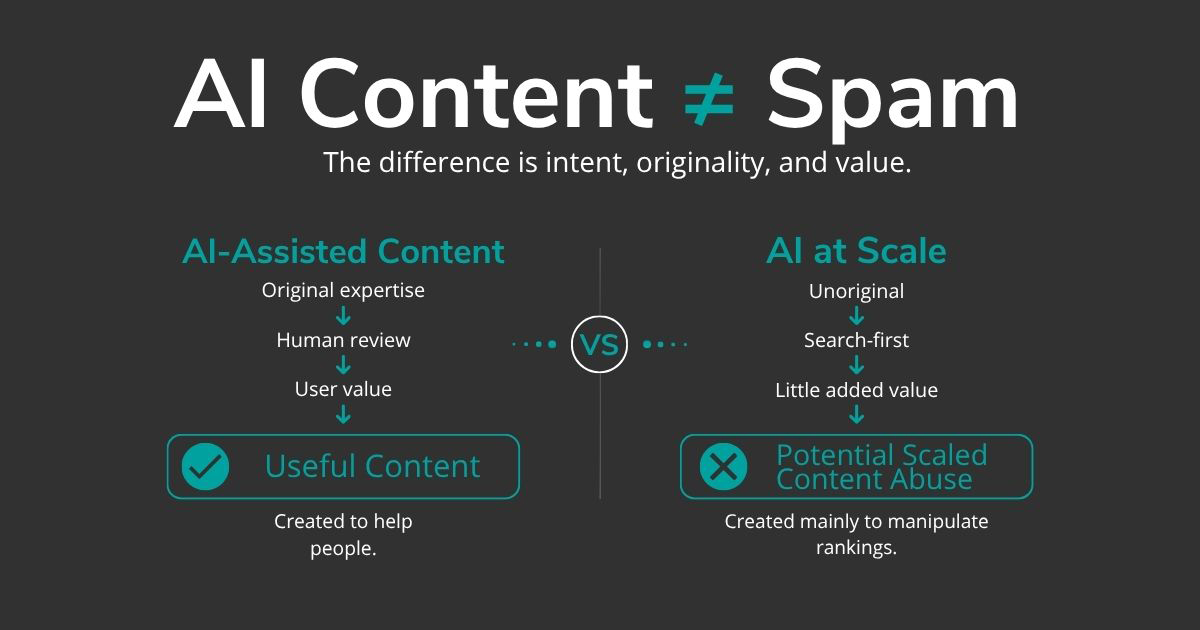
And Google’s policy applies regardless of how that content was produced.
AI can do it.
Humans can do it.
An outsourced content company can do it.
A combination of automation and human editing can do it.
In other words, slapping a human editor onto an AI workflow doesn’t automatically make the content valuable.
Google lists examples that include using generative AI to create many pages without adding value, republishing or transforming content from other sources without meaningful additions, combining information from multiple websites without contributing anything original, and creating large numbers of keyword-focused pages that offer little to readers.
And Google has now made clear that these spam policies don’t only apply to traditional blue-link search results. They also apply to generative AI experiences within Google Search.
That should get marketers’ attention.
The goal isn’t simply to get indexed anymore. As search evolves, businesses also want their brands and information to be understood, trusted, referenced, and potentially surfaced within AI-generated experiences.
Creating a mountain of commodity content isn’t a shortcut to getting there.
When Does AI Content Become an SEO Risk?
There isn’t a magic percentage of AI-generated copy that suddenly makes a page bad.
Instead, look at what the content contributes.
Some warning signs are fairly easy to spot.
Hundreds of Similar Location Pages
There are legitimate reasons for a multi-location business to have individual location pages. Customers need addresses, hours, directions, services, staff information, photos, reviews, and other locally relevant information.
But creating 100 nearly identical pages and swapping “Phoenix” for “Scottsdale” for “Tempe” isn’t suddenly a local SEO strategy because AI made it easy.
Each page should have a legitimate purpose and offer information relevant to the people in that market.
Blogs That Say Everything and Nothing
You’ve probably seen these.
They’re technically correct. Grammatically fine. Nicely organized.
And completely forgettable.
They summarize information that already exists on hundreds of other websites without adding firsthand knowledge, an expert perspective, original research, examples, experience, or anything else that makes the article worth reading.
AI didn’t invent this type of content.
It just made it much easier to produce.
Content Created for Every Possible Keyword Variation
This is particularly important as businesses begin optimizing for AI search.
It may be tempting to create a separate page for every question, conversational phrase, long-tail keyword, or possible AI prompt someone might use.
Google specifically cautions against this approach.
Modern search systems are much better at understanding meaning and relevance without requiring an exact-match page for every variation of a query.
You don’t need 75 pages saying essentially the same thing.
You need the best resource you can reasonably create around the subject.
“Best” Lists With No Real Basis
AI can produce a “10 Best Anything in Any City” article in seconds.
But why should anyone trust it?
Was anything actually tested? Were the businesses evaluated? What methodology determined the rankings? Does the publisher have experience with the products or services?
If the only reason the article exists is to capture a search query, that should raise questions before you publish it.
Content Outside Your Actual Expertise
This can become especially problematic for businesses publishing at scale.
A website develops authority in one area, discovers adjacent keywords with high search volume, and suddenly starts publishing hundreds of articles on topics barely related to the business.
AI makes that expansion incredibly easy.
But easy doesn’t mean strategic.
Your content should reinforce who you are, what you know, and why someone should trust you.
A Simple Question to Ask Before You Publish
There are plenty of technical ways to audit content, but one question cuts through a lot of the noise:
Would we still create this content if Google didn’t exist?
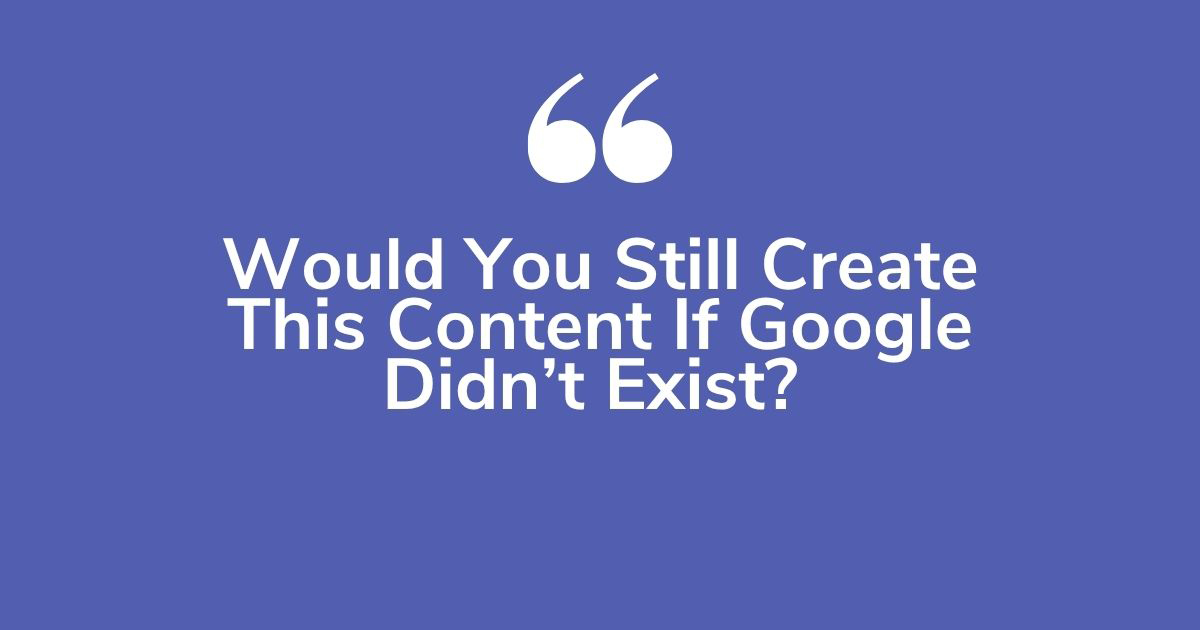
Would you still create this content if Google did not exist? AI content strategy question
Not every SEO-focused page will pass that test literally. Search demand is a perfectly legitimate reason to identify topics people care about, and keyword research still has an important role in content strategy.
The question is really about intent.
If someone arrived at this page directly, would it help them?
Would you be comfortable sending it to a prospective customer?
Does it demonstrate something your company actually knows?
Does it provide information that isn’t already available everywhere else?
Would anyone notice if it disappeared from the internet tomorrow?
That last one can sting a little.
But if the answer is no, producing another 50 pages just like it probably isn’t the solution.
What Should You Do With Existing AI Content?
If your company has already published AI-assisted content, don’t panic and start deleting everything.
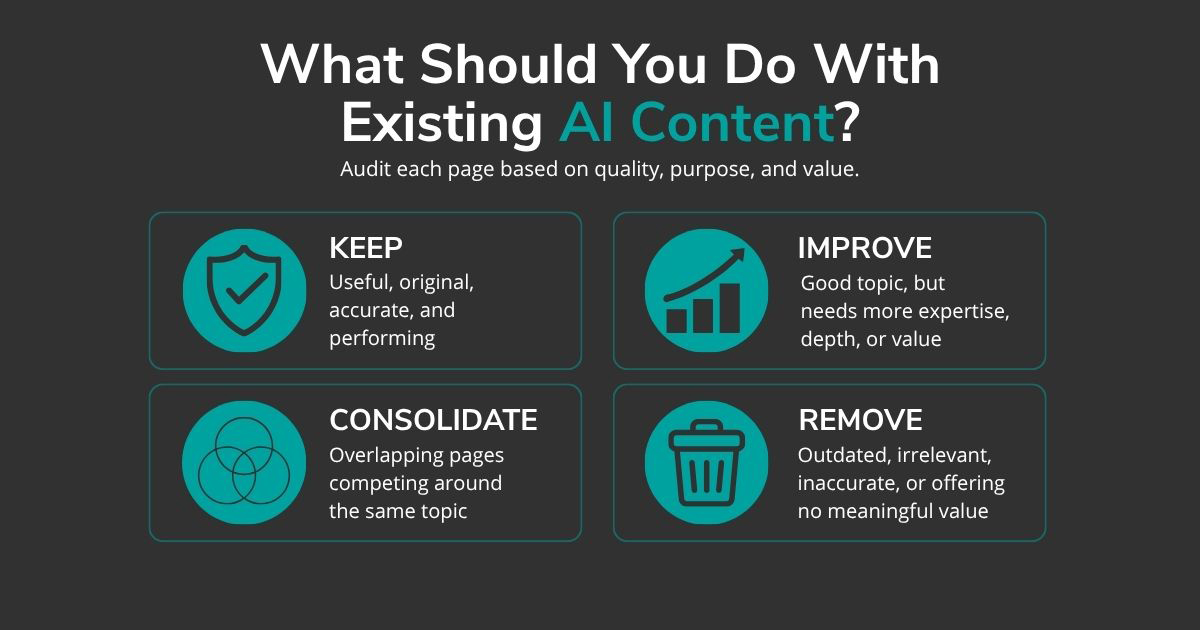
AI involvement alone is not a reason to remove a page.
Instead, audit the content based on quality, purpose, performance, relevance, and value.
Start by looking for patterns.
Do you have large groups of pages receiving no impressions or traffic?
Are multiple articles competing around essentially the same topic?
Do you have old posts that no longer reflect your expertise or current services?
Are there pages that read well but don’t actually say anything original?
Does the information remain accurate?
Can you identify who the content was intended to help and what they should gain from it?
From there, decide what each page deserves.
Some content may simply need updating. Some articles can be consolidated into a much stronger resource. Some pages need additional expert input, examples, statistics, visuals, or firsthand experience.
And yes, some content probably needs to go.
The goal isn’t to protect every URL you’ve ever published.
The goal is to make the website stronger as a whole.
Did the August 2026 Spam Update Affect Your Website?
If your organic traffic or rankings decline during a Google update, resist the urge to immediately start changing everything.
Algorithm updates can create volatility, and short-term movement doesn’t necessarily indicate a lasting problem.
Start with the data.
Compare organic search performance year over year where possible so seasonal changes don’t get mistaken for an algorithmic decline.
Review Google Search Console to determine whether impressions and clicks changed across the entire site or within particular directories, topics, pages, or queries.
Look at conversions, leads, and revenue alongside rankings and traffic. A decline in keyword count does not necessarily mean the business lost meaningful visibility.
And give the update enough time to roll out before drawing sweeping conclusions.
If there is a sustained decline associated with a spam update, then it’s time for a deeper review of Google’s spam policies and your website.
That review shouldn’t stop at AI content, either. Google’s spam policies address a much wider range of practices, including doorway abuse, link spam, site reputation abuse, expired domain abuse, cloaking, and other manipulative tactics.
Correlation is not diagnosis.
So, Should Businesses Stop Using AI for Content?
Absolutely not.
That’s not realistic, and we don’t think it’s necessary.
The better question is: What role should AI play in your content process?
The goal should be to incorporate AI into a thoughtful content marketing strategy, not use it as a replacement for strategy altogether.
AI can be incredibly useful for:
- Research and discovery
- Brainstorming topics and angles
- Organizing information
- Identifying questions audiences may have
- Analyzing large amounts of data
- Creating initial outlines
- Improving workflows and efficiency
- Repurposing existing original material
- Helping subject matter experts turn their knowledge into usable content
But somebody still needs to think.
Someone needs to determine why the content should exist, whether it’s accurate, what perspective the brand brings to the conversation, and whether the finished product is actually worth publishing.
That’s the part businesses shouldn’t automate away.
AI Search Makes Originality More Important, Not Less
There’s another reason this conversation matters beyond Google’s spam updates.
Search itself is changing.
AI Overviews, AI Mode, ChatGPT, and other generative search experiences can synthesize information from multiple sources and answer increasingly complicated questions without requiring users to visit ten different websites.
That creates a pretty obvious problem for commodity content.
If your article merely summarizes information AI can already summarize itself, why does the user need your article?
This is where experience, expertise, original data, unique perspectives, strong brands, and trusted sources become even more valuable.
The internet doesn’t need another generic definition.
It needs something worth referencing.
And businesses need to think beyond creating pages that rank to creating information that search engines, AI systems, journalists, customers, and other websites have a reason to trust and cite.
The Future of Content Isn’t Human vs. AI
We’ve spent a lot of time debating whether humans or AI should create content.
We think that’s the wrong debate.
The real divide is between content that contributes something and content that doesn’t.
A terrible article doesn’t become valuable because a human spent six hours writing it.
And an excellent resource doesn’t become worthless because AI helped organize the research.
The opportunity is in combining technology with the things technology can’t manufacture on its own: your company’s experience, customer insights, proprietary data, opinions, examples, creativity, and expertise.
Use AI to make your team better.
Don’t use it to make more internet.
The Bottom Line
AI content isn’t inherently putting your website at risk.
Bad content is.
The difference is that AI now allows businesses to create bad content at a scale we couldn’t have imagined a few years ago.
Google’s spam policies make its position fairly clear: creating large amounts of low-value content primarily to manipulate search visibility can violate its guidelines, regardless of whether that content came from AI, humans, or both.
So before you ask whether your company should be creating more content with AI, ask a better question:
Do we have something worth saying?
If the answer is yes, AI can be an incredibly powerful tool for helping you say it.
If the answer is no, hitting “generate” another hundred times probably isn’t going to fix the problem.
Concerned About Your Website’s Content Strategy
If you’re unsure whether your existing content is helping your visibility or creating unnecessary risk, learn more about our SEO and organic marketing services. We can evaluate your website, search performance, AI visibility, and overall content strategy to identify what’s working, what isn’t, and where there are opportunities to improve.
We’ll look at what’s working, what isn’t, and where there are opportunities to build stronger content around the expertise and authority your business already has.
Schedule a consultation with Eminent SEO.