
I’ve been doing SEO and digital marketing for over 20 years now, long enough to know when we’re facing a major shift, not just another algorithm tweak.
And right now?
We’re in it.
Clients are asking why rankings are dropping. Traffic is slowing down. Conversions are getting weird. Social media’s reach is tanking unless you’re willing to pay for every view. Google’s rolling out AI answers that steal clicks. And most of what used to work… just doesn’t anymore.
It’s not just noise, it’s a real shift.
So we’re hitting the reset button.
This post isn’t about panic. It’s about clarity.
Here’s what’s changed, what’s still working, and what we’re doing next – for ourselves, our clients, and the future of digital marketing.
What’s Changed in SEO (And Why It Matters)
It used to be simple: optimize your site, write blog posts with keywords, build some links, and you’d see rankings and traffic go up. That game is over.
Google has changed the rules. AI is writing the answers now. Search results are packed with featured snippets, AI summaries, maps, videos, and everything except your actual website link. Even paid ads are getting pushed further down the page. And if your site isn’t helpful, fast, mobile-friendly, and trustworthy, it might as well be invisible.
Search behavior has changed, too. People don’t just “Google and click” like they used to. They ask natural, conversational questions. They skim. They scroll. They bounce if the page feels off. And they expect answers immediately.
If your content doesn’t feel human, helpful, or experienced – it’s out.
That’s why the old strategy of publishing blog after blog with recycled tips or keyword-stuffed titles doesn’t just fall flat. It can actively hurt your brand.
So what do we do?
We stop chasing the algorithm.
We start focusing on what actually works in this environment: real value, real people, and content that’s built to last.
Why Everything Needs an Audit Right Now
“The SEO Rules Have Changed”
| Old Way | → | 2025+ Reality |
| Keyword-stuffed blogs | → | Helpful, original content |
| Being listed | → | Being trusted |
| Title tag tweaks | → | Full-page + entity optimization |
| Social = vanity | → | Social = authority signal |
| Google = main source | → | AI = cross-channel signal integration |
It’s tempting to keep doing what’s always worked: updating blogs, posting on social, tweaking title tags, running ads… but here’s the truth:
The rules have changed.
What Google values now is different.
What users want is different.
And what drives results? That’s evolving, fast.
So before you spend another dollar or write another post, it’s time to take a hard look at your digital presence. Not just the surface stuff, but the whole ecosystem – site, search, content, ads, social, email, reviews, video, tracking, the works.
Because here’s what matters now (and what doesn’t):
What Actually Matters in Digital Marketing Now
Let’s be honest. Most of the marketing “advice” floating around right now is outdated or straight-up useless. If you’re still trying to game the algorithm with keyword stuffing, AI-written fluff, or publishing just to stay on schedule, you’re wasting time.
Here’s what’s really working in 2025:
1. Content With Real Experience and Insight
Not blog spam. Not another listicle. Google wants to know: Do you actually know what you’re talking about? Firsthand experience and subject matter expertise are what set you apart. It’s not just about writing more, it’s about writing what only you can say.
2. Topical Depth and Structure
Gone are the days of one-off keyword blogs. You need content clusters: tightly connected, internally linked pages that build topical authority. If Google can’t see how everything fits together, it won’t see you as the expert.
3. Schema and Structured Data
If you’re not using schema markup, you’re missing out. It’s how search engines (and AI tools) understand your content. Want to show up in AI-generated results? Want your FAQs, videos, or articles to be featured? Mark your content up.
4. Strong UX and Mobile Performance
Fast-loading pages, clean navigation, mobile-first design: all non-negotiable. If your site feels outdated or clunky, users bounce and Google notices. And no, you don’t get points for “trying.”
5. Real Value to the User
Google is looking at whether people are actually engaging with your site. Are they staying on the page? Are they clicking through to other content? Are they filling out a form or watching a video? If not, you don’t just lose rankings, you lose trust.
What Needs To Be Phased Out

Not everything that used to work is worth saving. Some of it needs to go quietly. Other things need to be buried and never spoken of again.
Here’s what we’re actively leaving behind:
1. Keyword Stuffing and Shallow SEO Tactics
You know the ones, awkward phrases shoved into every paragraph just to “hit the keyword.” Google’s smarter than that now, and your readers always were. If it doesn’t sound natural, it’s not helping.
2. Thin, Generic Content
If your content could be written by ChatGPT or found on 10 other sites, it’s not doing anything for your brand. “What is divorce?” doesn’t cut it anymore. Real-world insight wins. Generic filler gets ignored.
3. Publishing Just to Publish
Blogging three times a week won’t save you if none of it says anything meaningful. More isn’t better, better is better. One strong piece of content that connects, converts, or ranks beats 10 that do nothing.
4. Low-Quality Link Building
No more spammy directory links, comment sections, or link wheels. That stuff doesn’t just fail, it can actually hurt you now. We’re focused on earned links through authority, relevance, and relationships.
5. Overextending on Platforms That Don’t Perform
Just because a platform exists doesn’t mean you need to be on it. If your ideal client isn’t on Pinterest, don’t waste energy there. We’re focusing on channels that bring in real results, not just noise.
6. Ignoring the Funnel
Driving traffic to your homepage and hoping for the best? Not anymore. If there’s no clear next step, no lead magnet, no conversion path – that traffic is going to bounce. We’re done wasting opportunities.
It’s SEO 25.0: AI Has Changed the Game
I’ve been doing SEO long enough to remember when keyword stuffing actually worked. When backlinks from spammy directories helped. When you could outrank your competitors just by having more blog posts.
That version of SEO is dead.
As my colleague, Chris Beckley, said: “We’re not on version 2.0 anymore, we’re at SEO 25.0”.
The algorithm doesn’t just index pages, it understands them. It reads context. It looks for intent. And more importantly, it’s being replaced in many cases by AI-generated answers that don’t even give users a reason to click through to your site.
Let’s break it down:
SEO Then vs. Now
| Area | A Few Years Ago | Now (2024–2025) |
| Keyword Targeting | Exact-match focus | Intent + natural phrasing |
| Content Strategy | More posts = more traffic | EEAT: Expertise, Experience, Authoritativeness, Trust |
| Ranking Factors | Backlinks + keywords | Engagement + satisfaction + AI readability |
| Search Experience | Click a result | Get an AI summary (no click needed) |
| Ads (Google) | Ads top results | AI pushes them down, CTR drops |
| Voice Search | Rare | Mainstream |
| Mobile Optimization | Nice to have | Critical |
| Technical SEO | Title tags, meta, speed | Still matters, plus schema + crawlability for AI |
| Link Building | Quantity mattered | Now: Quality, relevance, and trust |
| Local SEO | GMB, citations | Add: Reviews, proximity content, AI visibility |
This isn’t just a trend, it’s a whole new way of being found (or not being found at all).
What AI Search Means for Your Business:
- Your content may be read by AI, but not clicked
- Your site has to be so trustworthy and structured that Google’s AI wants to cite it
- Keyword rankings alone are no longer a clear indicator of success
- The focus now is authority, context, and user satisfaction
The new rules reward depth, not volume, and quality, not tricks.
What We’re Doing About It:
- We’re building content to earn citations, not just rankings.
- We’re using schema to make content readable to both humans and machines.
- We’re helping clients become sources, not just search results.
- And we’re teaching teams how to create content that connects, with both people and AI.
AI Is Reshaping Local SEO, Too
If you’re thinking, “Well, I don’t care about blog traffic, I just need local leads,” – heads up: AI is coming for local search too.
In fact, according to Search Engine Land, AI-driven local results are changing the game in three big ways:
1. Local packs are shrinking
AI-generated results (like Google’s Search Generative Experience) are starting to replace or compress the traditional map listings. That means fewer businesses get visibility, and if you’re not in the top 1–2, you’re basically invisible.
TL;DR: It’s no longer enough to just be “listed.” You need to be trusted.
2. Reviews and reputation now shape AI answers
AI tools are pulling language from your reviews and site to decide whether you’re credible and relevant. This means what people say about you, and how often, matters more than ever.
Action item: We’re leaning hard into review strategies, location content, and schema to make sure you show up.
3. Generic local content doesn’t cut it
AI is ignoring city-stuffed landing pages with nothing helpful or unique. If your location pages look like clones of each other with just the city swapped, they won’t get featured, ranked, or clicked.
Now’s the time to rewrite your location pages with real content, real value, and real local signals.
Why This Matters:
Your Google Business Profile, your reviews, and your local landing pages all now feed into how you show up in AI search, or don’t.
So if you’re relying on walk-ins, maps visibility, or “just being found in the area,” you need a serious local content and optimization strategy, not just a listing and a phone number.
The New Local SEO Funnel Looks a Lot Different
AI didn’t just tweak how people find local businesses, it flipped the funnel.
What used to be a straight path from a map to your website is now a dynamic journey shaped by AI, real-time data, reviews, and content relevance.
The Five Modern Pillars of Local SEO
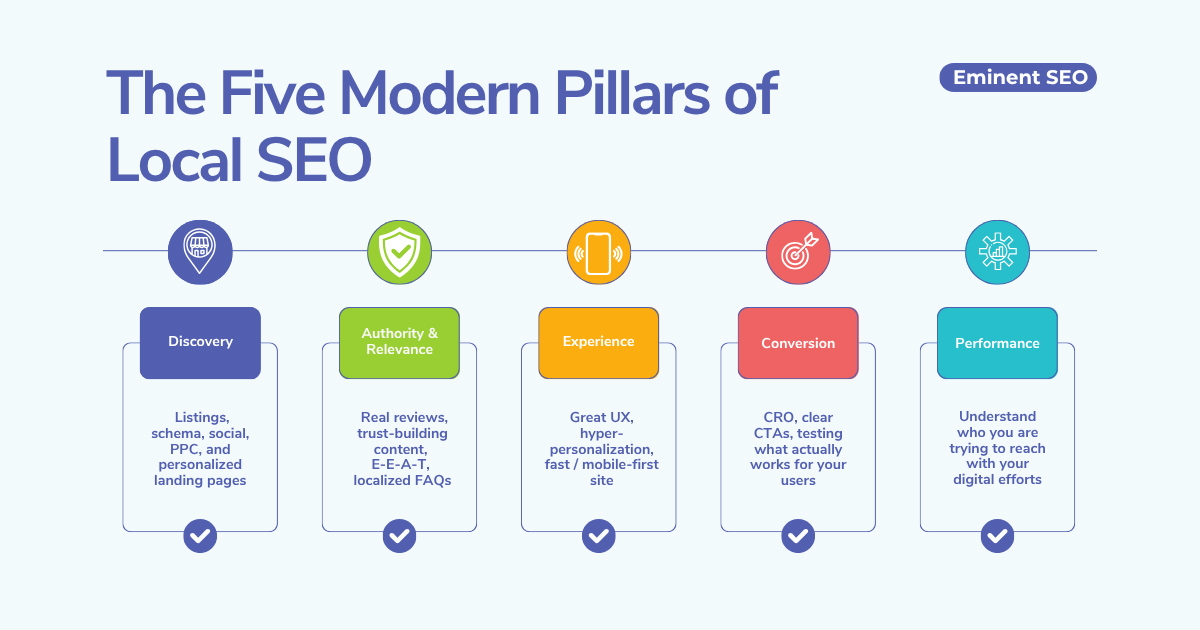
Here’s a simplified framework we use at Eminent SEO to help clients compete in today’s evolving search landscape:
- Discovery – Listings, schema, social, PPC, and personalized landing pages
- Authority & Relevance – Real reviews, trust-building content, E-E-A-T, localized FAQs
- Experience – Great UX, hyper-personalization, fast/mobile-first site
- Conversion – CRO, clear CTAs, testing what actually works for your users
- Performance – Use data across channels, not just from Google Analytics, to refine and optimize
At every stage – discovery, trust, experience, conversion, and performance – AI is influencing what shows up and who gets chosen. Your listings, your content, and even your customer feedback all feed into the algorithm.
If you haven’t rethought your local strategy through this lens, now’s the time.
It’s Time for an SEO Reset
SEO isn’t dead, it’s just evolved again. And honestly, we’ve been here before. Remember Panda? Penguin? BERT? Now it’s SGE, EEAT, and AI-assisted everything.
But here’s the truth: Google still wants what users want.
And that’s:
- Real expertise.
- Fast, user-friendly experiences.
- Content that actually answers questions, not just ranks for keywords.
- Businesses that earn attention, not just chase algorithms.
If you’re still chasing outdated tactics like thin blog posts, spammy backlinks, or keyword-stuffed pages, you’re playing checkers on a 3D chessboard.
It’s time for a reset.
We’re helping our clients audit what they have, cut what’s not working, and rebuild smarter systems based on what search (and people) actually value now. That means fewer shortcuts, more substance. Less noise, more signal.
Need help navigating the shift?
We offer full audits and custom strategies designed for where digital is going, not where it’s been. Reach out and let’s talk.
Want to Go Deeper?
We recently broke down how AI-driven search is changing the game, from SGE to zero-click results. Read: How AI is Reshaping SEO and Search Visibility