Search just shifted again. Google rolled out its June 2025 Core Update, and this one could be big. Not only is it rooted in AI advancements, but the messaging from Google hints that smaller, previously underrecognized sites may now get more visibility. That’s good news for high-quality niche content creators.
We’re also watching Google’s latest AI-powered ranking systems and something called MUVERA that might change how websites are discovered altogether.
Let’s dive into what this means, and how to stay ahead.
Google’s June 2025 Core Update: What You Need to Know
Google just announced its June 2025 Core Update, calling it “a regular update designed to better surface relevant, satisfying content for searchers from all types of sites.” That last part is key, Google may be shifting toward more diversity in what it surfaces, potentially giving a boost to smaller or lesser-known sites.
What’s behind this? Likely more AI advancement.
Here’s what we’re watching:
MUVERA (Multi-Vector Embedding Retrieval Architecture) – Google says it’s now easier to precisely retrieve and re-rank content using neural embeddings.
Expect results to feel more context-aware and exact.
Timing suggests the update aligns with or is leading up to a new version of Gemini AI.
Our take: Content relevance and satisfaction signals are more important than ever. Sites that focus on helpful, nuanced content will have an edge – especially if they’re optimized for semantic and vector-based search retrieval.
Let’s Talk Strategy:
While many SEOs are scrambling to adapt, here’s your edge, focus on:
Topical authority – Publish content clusters that deeply explore your subject matter.
Clear structure – Help search engines understand your content with headers, internal links, and clean formatting.
User experience – Fast load times, accessible design, and satisfying content = better rankings.
Gemini updates drive SEO shifts: Most recent core updates have dropped within 1–2 weeks of major Gemini model releases.
Structured content matters: Google’s AI is improving at identifying sections of content that meet search intent – make yours scannable and structured.
Featured Blog Post
Adapting Your SEO Strategy for AI-Driven Search
As Google’s ranking systems evolve, so should your SEO strategy. In our latest post, we explore what AI-powered search really means—breaking down MUVERA, Gemini, and how semantic relationships are reshaping search results. Whether you’re a business owner or a strategist, this is your roadmap to staying visible in the age of AI.
Eminent SEO provides strategic SEO campaigns with measurable results along with expert website design, development, pay per click, content and social media and organic website marketing. 800.871.4130.
Search is changing. And not in the small, iterative way we’re used to. I’m talking about the kind of shift that flips the table and makes you question whether you’re still playing the same game.
We’ve been watching it happen – quietly at first, then louder. Google’s no longer just a search engine. It’s becoming an AI-powered answer machine. Your carefully optimized content might still rank, sure. Or it might just get digested and summarized into a neat little AI Overview, with your name nowhere to be found. Neat.
But here’s the thing: we saw this coming. We’ve been preparing. And now we’re doing what we’ve always done – adapting, evolving, and keeping our clients ahead of the curve while others are still trying to figure out which curve we’re even on.
Let me tell you how.
Search Isn’t What It Used to Be
Let’s not pretend that dropping a few keywords into a blog post and calling it SEO ever really cut it. But at least we used to have a clear goal: rank on page one, get clicks, convert traffic.
Now? Search is becoming an experience. Google’s AI Mode is front and center. OpenAI, Perplexity, and who knows what else are pulling in content, distilling it, and skipping the courtesy of a click.
What does that mean for your site, your content, your visibility?
It means if your content doesn’t inform the machine, it’s invisible. If it doesn’t get referenced by the overview, it might as well not exist. That’s not doom and gloom. That’s just reality. And the sooner you adapt, the better you’ll do.
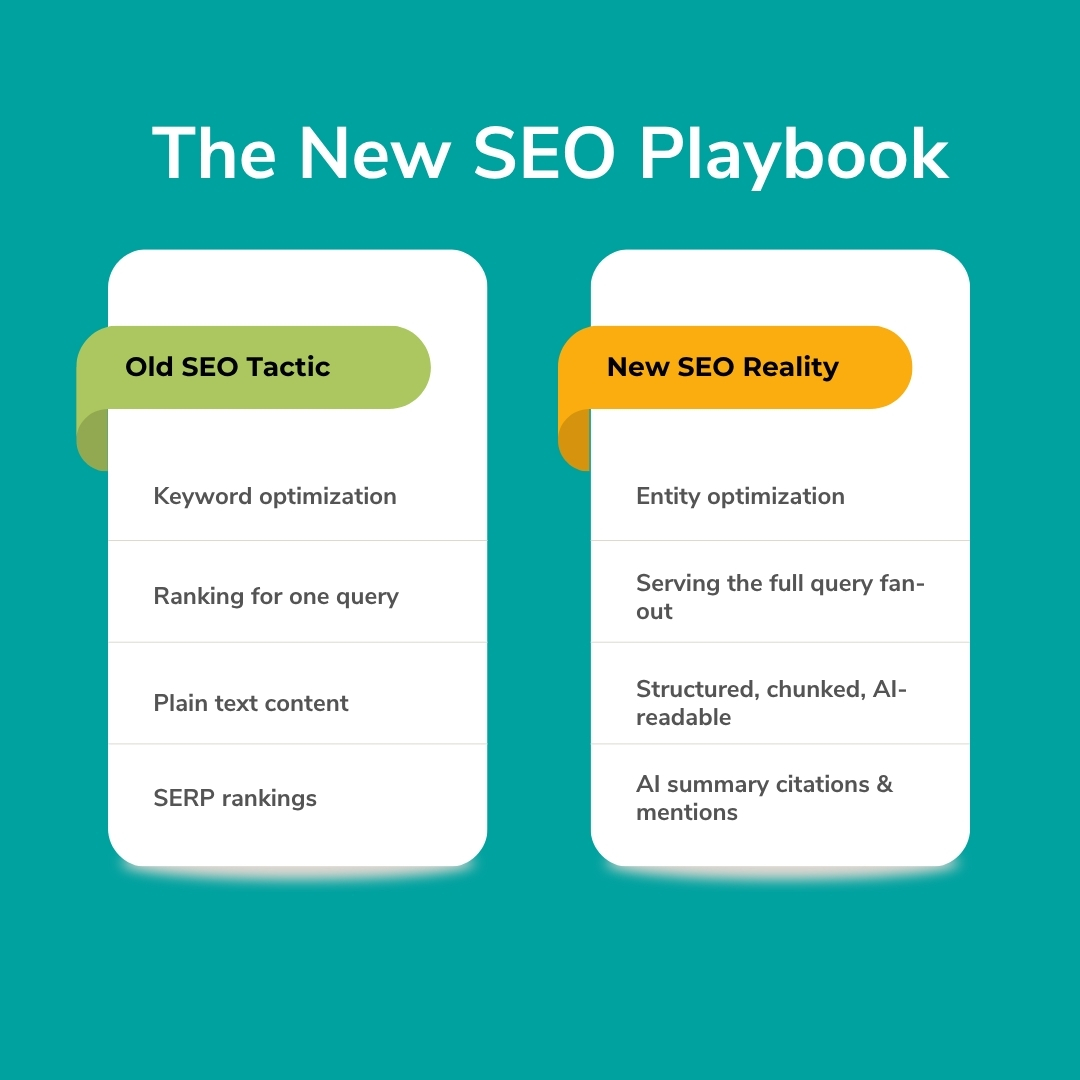
We’re Rewriting the SEO Playbook
At Eminent SEO, we’re not clutching old tactics like they still work just because they used to.
Here’s what we’re doing instead:
We’re creating content that anticipates the query fanout – the cascade of follow-up questions an AI system might generate from a single search.
We’re focusing on structured, semantically rich content that AI systems can actually understand and reuse.
We’re optimizing for entity awareness, not just keywords. Google isn’t looking at your text. It’s mapping concepts and relationships. If your content isn’t contributing to that graph, you’re out of the conversation.
Yes, we still care about rankings. But we care more about influence, about making your brand part of the dataset that feeds the future of search.
Yes, We’re Building AI Agents Too
This isn’t some distant thing we’re watching from afar. We’re in it. We’re building and testing AI agents in-house – tools that help us audit websites, ideate content, manage workflows, and more. Not because it’s trendy. Because it works.
Imagine reviewing 50 blog posts with a trained agent that flags outdated data, suggests structural improvements, and drafts new meta descriptions on the fly. That’s not the future. That’s Tuesday.
And soon, some of our clients will be using these agents too, customized to their voice, brand, and goals. The same way you have a team now, you’ll soon have a team plus one: your own AI.
What This Means for You
If you’re our client, this means you’re not just along for the ride. You’re already benefiting from a strategy that’s built for where search is going, not where it was.
We’re positioning your content to be used in AI answers, not just ranked in SERPs. We’re helping you stay discoverable, not just indexable. And we’re exploring new platforms where your audience will be searching next, from ChatGPT’s browsing tools to Gemini and beyond.
If you’re not our client? Well… good luck out there. Just kidding. (Kind of.)
Think Beyond the Search Text Box
Search isn’t just text anymore. It’s conversational, visual, and in many cases, vocal. People are getting answers from voice assistants while cooking dinner, scanning TikTok transcripts, or using image-based queries. If your content only works in paragraph form, you’re missing half the equation.
We’re already helping clients shift their messaging to work across formats – that means tightening language, structuring content so it makes sense out loud, and optimizing assets that play nice with visual search and AI models. Because if your answer can’t live outside of a blog post, it’s going to get left behind.
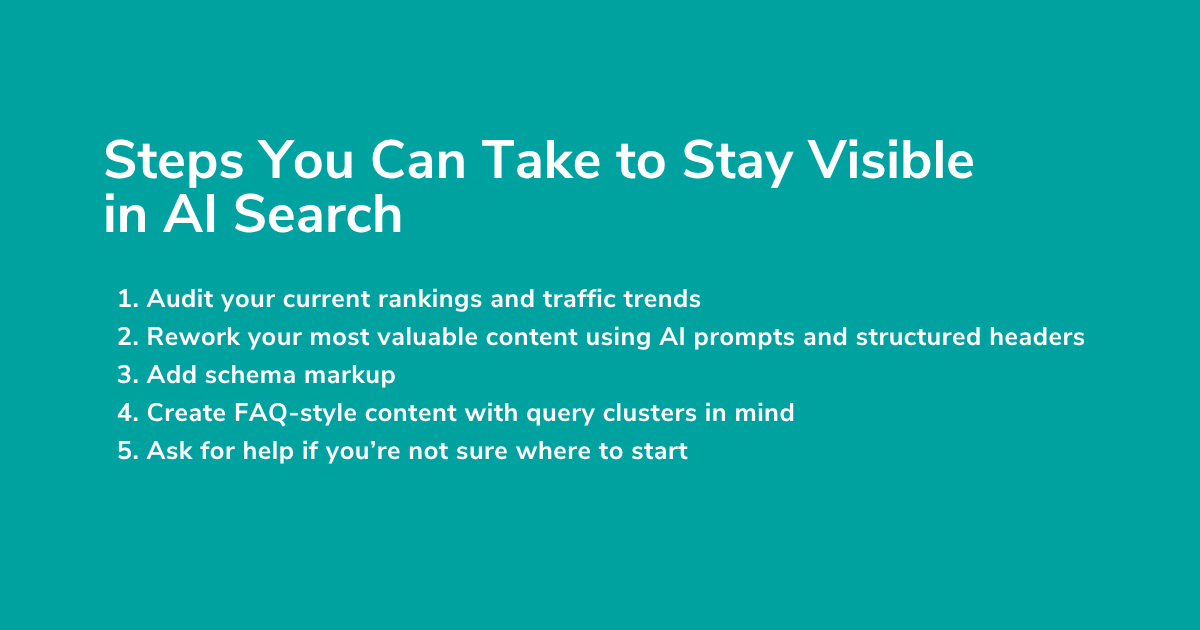
How to Prepare Your SEO Strategy for AI
If all of this AI talk has you wondering whether your SEO strategy still holds up, you’re not alone. But this isn’t the time to panic – it’s the time to get proactive. Here’s what you can (and should) be doing right now to stay ahead of the search shift.
1. Audit your current rankings and traffic trends
Look closely at your top-performing pages. Are they still getting traffic? Or have impressions and clicks started to dip, especially on informational queries? It’s not just seasonality. AI Overviews are swallowing up traffic, and you need to know where you’re losing ground so you can start shoring it up.
2. Rework your most valuable content using AI prompts and structured headers
This isn’t about stuffing keywords. It’s about rewriting content to serve AI systems and human readers alike. Think: clean headers, concise sections, entity-rich language. If your article doesn’t answer multiple, related questions in a clear, chunked format, it’s not as useful to AI as it could be.
Tip: Use AI (yes, the same tech that’s eating your clicks) to help you reformat and expand your content more strategically. Just don’t let it write like a robot.
3. Add schema markup
Seriously, if you’re still ignoring structured data, I don’t know what to tell you. Schema is one of the easiest ways to give Google context, and potentially get pulled into AI-generated summaries. Begin with FAQs, articles, and how-to guides.
4. Create FAQ-style content with query clusters in mind
Think beyond a single search. AI Mode is all about the next question, and the five after that. Structure your content so it answers a full fan-out of related questions in one go. This isn’t just good for AI visibility – it’s what your audience actually wants.
5. Ask for help if you’re not sure where to start
If this all sounds great, but you don’t have the time (or brain space) to implement it, that’s what we’re here for. Reach out. We’ll help you identify what’s working, what needs work, and how to future-proof your SEO strategy before your traffic quietly disappears.
What Not to Do in the Age of AI Search
As AI-driven search evolves, some brands are making the wrong moves.
Here are a few mistakes to avoid if you want to stay visible:
Keyword stuffing is back (and still bad): Over-optimizing content with awkward, repetitive phrasing doesn’t help, it actually confuses AI models and hurts readability.
Publishing low-quality AI content at scale: Mass-producing generic blog posts using AI tools without editing or insight won’t earn trust from users or search engines.
Ignoring structured data (schema): AI engines rely on structured signals. Skipping schema markup means missing out on visibility in rich results and generative answers.
Assuming Google will “figure it out”: AI still needs guidance. Clear organization, internal linking, and semantic clarity matter more than ever.
The takeaway? Don’t chase shortcuts. Build clarity, credibility, and real value into every piece of content.
Top Questions About AI-Driven Search and SEO
Wondering how AI is actually changing search and what it means for your rankings? You’re not alone. We’ve rounded up the most common questions clients ask us about AI, SEO, and where all of this is heading, with real answers, not fluff.
How is AI changing SEO right now?
AI is shifting the way people search and how search engines respond. Tools like Google’s AI Overviews, ChatGPT, and Gemini are summarizing answers from multiple sources, often without sending traffic back to websites. Traditional SEO still matters, but now your content also needs to feed machines, not just rank in SERPs.
What is AI Mode, and how does it affect my content?
Google’s AI Mode (formerly known as SGE) is designed to provide AI-generated answers directly in the search results. That means your content needs to be well-structured, deeply informative, and optimized for relevance, not just keywords, if you want it to be cited or included.
Can SEO still drive traffic in the age of AI Overviews?
Yes, but the approach needs to evolve. Instead of chasing just clicks, brands need to focus on visibility. That means showing up in AI summaries, getting mentioned by name, and building authority across multiple formats – text, video, voice, and beyond.
What is entity SEO, and why does it matter now?
Entity SEO focuses on connecting your content to identifiable people, places, concepts, and brands – the building blocks of how AI systems understand the world. If your business isn’t part of that semantic map, you’re far less likely to be surfaced in AI-generated answers.
What is Generative Engine Optimization (GEO)?
Generative Engine Optimization (GEO) is the practice of optimizing content specifically for AI-powered search engines and tools, like Google’s AI Overviews, ChatGPT, and Perplexity. Instead of focusing solely on keyword rankings, GEO strategies aim to make your content useful to AI systems so it can be summarized, cited, or used in responses. It’s not replacing SEO — it’s evolving it.
Should I optimize for AI tools like ChatGPT and Gemini, or just focus on Google?
It’s not either-or anymore. Search behavior is fragmenting, and users are getting answers from a mix of traditional search engines and generative AI tools. We’re helping clients create content that performs across both by making it structured, conversational, and entity-rich. If you’re only optimizing for Google, you’re missing part of the landscape.
How can I prepare my content for AI-driven search?
Start by auditing your top-performing content. Then rework it using clear headers, structured sections, and schema markup. Build out FAQ clusters, focus on user intent, and look at how your content reads out loud. If you’re not sure where to start, we can help.
Will traditional SEO still matter in the future?
Yes, but it’s evolving. The technical foundation (site speed, crawlability, internal linking) still matters. What’s changing is how content is discovered and used. SEO is no longer just about ranking pages. It’s about making sure your content is part of the AI-driven conversation, no matter where it happens.
Final Thoughts on SEO in the Age of AI
AI didn’t kill SEO. But it is forcing it to grow up… fast. We’re not in the business of hand-wringing or nostalgia. We’re in the business of building strategies that work, no matter how the landscape shifts.
If you’re still doing SEO the same way you were two years ago, you’re behind. That’s not meant to scare you, it’s just the truth. The brands that win from here on out will be the ones that adapt early, test often, and aren’t afraid to rethink everything.
We’re already doing that. And if you’re ready, we’ll do it with you.
CEO, Business Consultant, Researcher and Marketing Strategist
Jenny Weatherall is the co-owner and CEO of Eminent SEO, a design and marketing agency founded in 2009. She has worked in the industry since 2005, when she fell in love with digital marketing… and her now husband and partner, Chris. Together they have 6 children and 3 granddaughters.
Jenny has a passion for learning and sharing what she learns. She has researched, written and published hundreds of articles on a wide variety of topics, including: SEO, design, marketing, ethics, business management, sustainability, inclusion, behavioral health, wellness and work-life balance.
Lately, I’ve been in conversations with clients, teammates, and even competitors, and one thing’s become clear: SEO as we knew it is gone. It’s not dramatic. It’s just the truth. Google is rolling out features faster than most people can follow, but that’s what we’re here for.
This month, I’m keeping it tight. Just the key insights we’re acting on – the ones worth your time and energy.
Let’s get into it.
AI Mode is Here.
And It Doesn’t Care About Your Rankings
Google’s AI Overviews (also called AI Mode) are live and already changing visibility for millions of keywords.
What we’re seeing:
Only about 13 percent of keywords triggered an AI Overview in March, but the number is growing.
Most URLs featured in AI Mode are not ranked in the top 10 organic results.
AI Mode goes deep. It doesn’t just pull what ranks well; it pulls what answers the question well.
What’s working now:
Structured content with clear takeaways
Pages that include custom visuals
Original, helpful perspectives instead of summaries or rehashed information
Tip: Don’t optimize for keywords. Optimize for the kinds of questions people are really asking.
150 Days or You’re Out
New research confirms that if Google hasn’t crawled your page in 150 days, it likely won’t get indexed.
This is affecting new content, low-authority URLs, and older posts that haven’t been updated or linked to.
What we’re doing for clients:
Running internal linking audits
Checking sitemap and GSC health
Refreshing and republishing content worth keeping
Need help identifying what’s been left behind? Just reply.
“Menu-Based” SEO is the Move
Seth Godin said, “People prefer multiple choice to essay exams.”
This applies to AI tools and user experience. If you’re relying on users or AI to guess what to do next, engagement drops.
How we’re adjusting:
Adding “Ask Me” style prompts under blog sections
Including TLDRs and step-by-step guides
Designing content with modular answers and interaction points
Quick Fix of the Month
Open Google Search Console, go to Crawl Stats.
Look at when your most important pages were last crawled. If it’s been more than 60 days, flag it.
Those pages may be at risk.
Prompt of the Month
Use this in Gemini or ChatGPT to identify content gaps:
“Review this article and tell me what a user would still be confused about after reading it. Suggest content I can add to improve clarity and make it AI Mode-friendly.”
What We Believe Right Now
AI Mode will eventually replace traditional search
Content that includes original insights, structure, and visuals will perform better
Helpful content means anticipating the next question before it’s asked
If your content isn’t truly helping, teaching, or inspiring, AI isn’t likely to surface it.
Final Word
If your content has lost visibility recently, it’s not your fault.
The rules changed. The good news is, we’re already adapting.
If you need help with the next step, we’re ready.
Jenny Weatherall
Featured Service
Data and insights from the SEO audit form the foundation of an SEO strategy. This includes developing a brand’s buyer personas and identifying what their ideal audiences is looking for when they browse the Web. This information can be developed into a website information architecture that satisfies search engines while delighting users.
Eminent SEO provides strategic SEO campaigns with measurable results along with expert website design, development, pay per click, content and social media and organic website marketing. 800.871.4130.
Hey There,
Q2 is here already – if you’re feeling like Q1 flew by and you’re still waiting for your marketing to “click,” you’re not alone. A few smart adjustments this month could make a real difference in how you finish the first half of the year.
Here’s what we’re seeing and what you should be paying attention to right now.
Let’s Talk AI + Search
A few key shifts are happening – and they’re big.
AI Overviews are showing up more often in Google results since the March core update. That means fewer clicks for some sites. If your traffic dipped, this might be why.
You can now track traffic from tools like ChatGPT. If LLMs are quoting or referencing your site, it’s measurable now (thanks to a great Looker Studio template – hit us up if you want it).
Gemini 2.5 is live and powering a lot of these changes. It’s smarter and more context-aware, so the quality bar for content just got higher.
Bottom line: If your site is full of generic, keyword-stuffed content, it’s time to rewrite it – or risk losing visibility
SEO: Local Tips That Still Work
Old-school still wins when done right:
Add your business address to the footer of your site – even if you’re a service-area business. People are testing this and seeing boosts in both organic and local rankings.
Simple fix, real results.
Email: What’s Getting Opens Right Now
Short, helpful, personal. That’s what’s working.
Over-designed emails are underperforming. The more your email looks like a sales flyer, the more it gets ignored.
People want useful info – not just discounts. Give them tips, insights, behind-the-scenes stuff. That builds trust and keeps you top of mind.
What You Should Do in April
If you do nothing else this month:
Refresh 2–3 top-performing pages on your site
Check site speed and fix what’s slowing it down
Segment your email list and test new subject lines
Revisit your lead gen flow – what’s working, what’s not?
Need help? You don’t have to guess. We’re doing this stuff every day, and we’d love to help you move the needle. Reply to this email and let’s talk strategy.
Until next time,
Jenny Weatherall & the Eminent SEO Team
Featured Service
Powerful Email and Newsletter Marketing Services
Here at Eminent SEO, we offer email marketing services to help you stay in constant contact with your prospects, supply them with enticing offers and share useful information about your company. A smart email marketing campaign includes great branding, impactful design, focused content and established tracking metrics. We can help you do it all.
Eminent SEO provides strategic SEO campaigns with measurable results along with expert website design, development, pay per click, content and social media and organic website marketing. 800.871.4130.
Q1 is moving fast, and if you’re not seeing the leads or results you expected, it’s time to pivot. We’ve been tracking SEO updates, email marketing strategies, and Google’s latest changes, and here’s what you should be focusing on this month.
No fluff – just actionable insights.
Good to Know in SEO & Digital Marketing
Staying ahead of search engine and marketing changes is key to long-term success.
Here’s what’s happening right now:
Google Cracks Down on ‘Parasite SEO’ – Google is penalizing sites that host unrelated third-party content (think spammy affiliate pages). If your SEO strategy involves third-party content hosting, it’s time to rethink your approach. (The Verge)
Authentic, Human Content Is Winning – Google and users are favoring real, human-written content over AI-generated spam. If you’re relying too heavily on AI to create content, make sure you’re adding real expertise and value. (Wired)
AI Search & SEO Are Evolving – Google’s Gemini 2.0 and AI-powered search are changing how search results work. The focus? More intent-driven results with less reliance on traditional rankings. If you’re not adapting, you’ll start falling behind. (Forbes)
Your Website: Is It Helping or Hurting Your Business?
Your website should be a sales tool, not just a digital brochure. If it’s not bringing in leads, it’s time to fix what’s broken.
Speed matters. If your site is slow, visitors leave. Run a speed test (Google PageSpeed Insights is free) and fix anything that’s slowing it down.
Are your calls to action clear? If someone lands on your homepage, is it obvious what they should do next? Make sure your CTAs are easy to see and use.
Content needs to stay fresh. Google rewards updated content. If you haven’t touched your top-performing pages in over a year, update them now.
What to do this month:
Run a site speed test and fix issues.
Check your forms—are they simple and working?
Look at your top 10 landing pages and make sure they’re optimized for conversions.
[/su_lis]
Email & Automation: Stop Letting Leads Slip Away
Most businesses don’t need more leads—they need to convert the ones they already have.
Automate your follow-ups. Most people won’t buy or book on the first visit. A well-timed follow-up email can make the difference.
Segment your list. Not every subscriber should get the same message. Personalization increases open rates and sales.
Improve your email engagement. If your open rates are low, test new subject lines. If clicks are low, simplify your emails and focus on one clear call to action.
What to do this month:
Set up automated emails for new leads.
Test a new subject line strategy.
Clean up your email list—remove inactive subscribers.
Content & Social Media: Less Noise, More Impact
If you’re posting all the time and getting nothing in return, it’s time to rethink the strategy.
Post less, but better. One well-thought-out post will do more for your business than five generic ones.
Repurpose your best content. If a blog is performing well, turn it into an email, LinkedIn post, or short video.
Use video, but keep it simple. You don’t need fancy production—quick insights and behind-the-scenes content go further.
What to do this month:
Look at what’s working and do more of it.
Repurpose your best-performing content.
Test a short-form video, even if it’s just a quick business tip.
The One Thing to Prioritize in March
If you do nothing else this month, optimize your website and automate lead follow-ups.
A slow site and a messy sales funnel are costing you business. Fix them now.
Need help figuring it all out? Reply to this email and let’s chat.
Until next time, Jenny & the Eminent SEO Team
Featured Service
High Quality Website Design and Development
When it comes to design, quality is everything. But, a quality website design is much more than aesthetic. It’s the usability. The expandability. The flexibility. The longevity. The creativity. We believe that a great website requires clean, responsive code, user friendly navigation search engine optimized page content and beautiful designs.
Eminent SEO provides strategic SEO campaigns with measurable results along with expert website design, development, pay per click, content and social media and organic website marketing. 800.871.4130.
We’re back with some fresh insights from the wild world of online marketing.
But first… did you catch the big game? More importantly—what was your favorite commercial? (We all know that’s the real reason we watch.)
What’s Happening Right Now
Google Reviews Gone Missing? You’re Not Alone!
Two of our clients just reached out asking why so many real reviews vanished overnight. Turns out, Google confirmed an outage in business profile reviews, leading to missing reviews for many local businesses. They’re actively working on a fix. Stay tuned!
Google is internally testing a new AI-driven search mode that intelligently researches and organizes information with external links. Expect fewer clicks to websites if this takes off.
Major Updates to Google’s Rater Guidelines (Jan 2025)
The newest rater guidelines put original content front and center while cracking down on:
OpenAI just dropped o3, a more advanced, reasoning-focused AI model. They also announced “Deep Research,” which is funny because… Google already has a product with that name. 🤔
GSC + GA4 Data Now in Looker Studio
Need better reporting? Google just released a Looker Studio dashboard that combines Google Search Console and Google Analytics 4 data for a more comprehensive view of your website’s performance.
Local SEO: Weather Reports, New SERP Features & More
Local SEO Guide has launched a SERP Weather Report to track ranking fluctuations in home services across major US cities.
Google is testing new search features, including:
AI-organized search results
“Popular Products” feature
People Also Search in Images
“Related Places” for local searches
New SERP Review Features
Need Help Navigating the Chaos? Let’s Chat.
If you’re ready to improve your rankings, clean up your SEO, or just figure out where the heck your reviews went, we’re here to help.
📩 Reply to this email or hit me up here. Let’s get to work.
Until next time,
Jenny Weatherall & the Eminent SEO Team
New From Our Blog
The Ultimate Guide to Law Firm SEO and Digital Marketing Success
Learn proven SEO and digital marketing strategies to help your law firm rank higher, attract more clients, and achieve sustainable growth. READ ->
Selling a Law Practice: How Smart Marketing Increases Value & Attracts Buyers
Thinking of selling your law firm? Learn how strategic marketing can boost value, attract buyers, and ensure a smooth transition for your practice. READ ->
Eminent SEO provides strategic SEO campaigns with measurable results along with expert website design, development, pay per click, content and social media and organic website marketing. 800.871.4130.
As we close out another incredible year, the marketing landscape continues to evolve faster than ever. From groundbreaking AI advancements to shifting SEO strategies, December has been packed with updates that are shaping the future of digital marketing.
In this edition, we’re covering:
The latest in AI tools like Google’s Gemini 2.0.
SEO trends that demand your attention as we head into 2025.
Actionable tips for creating sustainable, audience-driven strategies.
Let’s dive in!
The Biggest AI Updates Shaping Marketing
AI isn’t the future—it’s the now.
Here’s what’s shaking things up:
Google’s Gemini 2.0 introduces AI agents like Project Astra (for glasses) and Project Mariner (embedded in browsers). Search is evolving to meet users wherever they are.
OpenAI’s Sora brings text-to-video content creation to marketers, redefining storytelling at scale.
Google’s Willow chip advances quantum computing, paving the way for more powerful AI applications.
📌 Action Tip: Start experimenting with AI tools to automate and personalize your campaigns, but always keep your audience’s needs at the center.
SEO in 2025: Old Rules, Smarter Play
The fundamentals of SEO remain, but smarter strategies are essential:
Content audits are critical. Outdated or spammy content will hurt rankings—cleaning house is a must.
eCommerce evolution. Optimized product pages are no longer optional with Google refining how products are displayed.
Reputation wins. Expertise, authority, and trustworthiness (E-E-A-T) are key differentiators in rankings.
📌 Action Tip: Map your buyer’s journey and refresh content regularly to meet changing user intent
Marketing Trends to Watch in 2025
It’s not just about AI and SEO—broader trends are redefining how brands connect:
Social Media Commerce: Platforms like TikTok and Instagram are doubling down on shopping features.
Sustainability Messaging: Brands demonstrating care for the planet are winning consumer loyalty.
Short-Form Content: TikToks and Reels reign supreme in engagement metrics.
📌 Action Tip: Lean into audience-first storytelling. Use short-form video to connect authentically while exploring new commerce features.
What This All Means
2025 will be the year of adaptability and authenticity. Success won’t come from just having the best tools—it will come from understanding your audience deeply and using technology to enhance their experience.
As always, we’re here to help you navigate these changes. Whether you’re looking to refine your SEO strategy, leverage AI tools, or simply brainstorm new ideas, let’s make 2025 your strongest year yet.
Resources & Updates
🌟 Don’t forget to check out our recent blog posts for in-depth insights into SEO strategies, AI updates, and actionable marketing tips:
Eminent SEO provides strategic SEO campaigns with measurable results along with expert website design, development, pay per click, content and social media and organic website marketing. 800.871.4130.
This year has been a whirlwind for marketers, and the pace isn’t slowing down. Between major AI breakthroughs and evolving SEO trends, staying ahead feels like running a marathon on a treadmill—fast and never-ending.
The marketing landscape is evolving faster than ever. With the rise of AI tools like Google’s Gemini 2.0 and OpenAI’s Sora, combined with Google’s constant algorithm updates, it’s clear we’re operating in a world where change is the only constant.
For marketers, this presents both an opportunity and a challenge. The opportunity lies in leveraging cutting-edge tools to gain an edge over competitors, build meaningful connections with audiences, and deliver impactful campaigns. The challenge? Keeping up with these rapid advancements while staying true to what matters: understanding your audience and creating value.
2025 won’t be about who has the fanciest tools—it’ll be about how you use them.
Success will belong to those who adapt quickly, embrace new technologies thoughtfully, and integrate them seamlessly into strategies that resonate with their audience.
Let’s break down what you need to know right now and how to prepare for the future:
The Biggest AI Updates Shaping Marketing
AI is no longer just a buzzword—it’s redefining how we work, strategize, and connect. As we move into 2025, the advancements in AI tools and capabilities are transforming the marketing landscape at an unprecedented pace.
Here’s what’s happening and what it means for marketers:
Key AI Innovations to Watch
Google’s Gemini 2.0
This cutting-edge AI model introduces tools like Project Astra (glasses-based AI) and Project Mariner (AI embedded in browsers). These innovations make Search more interactive and personal, meeting users exactly where they are—whether it’s in the real world through glasses or on their desktops.
Why It Matters: The way people search and interact with online content is changing. Marketers need to think beyond traditional keywords and start considering conversational, intent-based queries that these tools will prioritize.
OpenAI’s Sora
Text-to-video capabilities are no longer a future dream—Sora is making it a reality. With the ability to generate high-quality video content from text prompts, marketers now have an opportunity to scale storytelling like never before.
Application Idea: Create short, engaging explainer videos for social media campaigns, email marketing, or even landing pages.
Google’s PaliGemma Model
This model focuses on emotion detection, enabling AI to understand and respond to human emotions better. The shift toward empathetic marketing means campaigns can become more personalized and emotionally resonant.
How to Use It: Leverage AI to analyze customer sentiment in real time and adjust messaging to fit their emotional state, improving customer experience.
Google’s Willow Chip
This quantum computing chip promises to make AI models faster and more accurate, paving the way for more sophisticated applications in everything from predictive analytics to content generation.
Impact on Marketing: Faster AI means quicker insights and the ability to test and optimize campaigns in real time.
What This Means for Marketers
AI tools are powerful, but their success depends on how you integrate them into your strategy.
Here’s how to make the most of these innovations:
Focus on Audience Understanding: Use AI to gain deeper insights into your audience’s needs, preferences, and behavior. Tools like emotion detection or predictive analytics can help you anticipate customer needs and create highly targeted campaigns.
Humanize Your Campaigns: While AI can automate and optimize, don’t lose sight of the human element. Combine AI efficiency with authentic messaging to build trust and connection.
Experiment with Emerging Tools: Start small by testing AI tools in areas like content generation, customer support, or analytics. Learn what works for your brand and audience before scaling.
Stay Agile: As tools like Gemini 2.0 and Sora evolve, keep your strategy flexible. Be ready to adapt to new search behaviors, content formats, and consumer expectations.
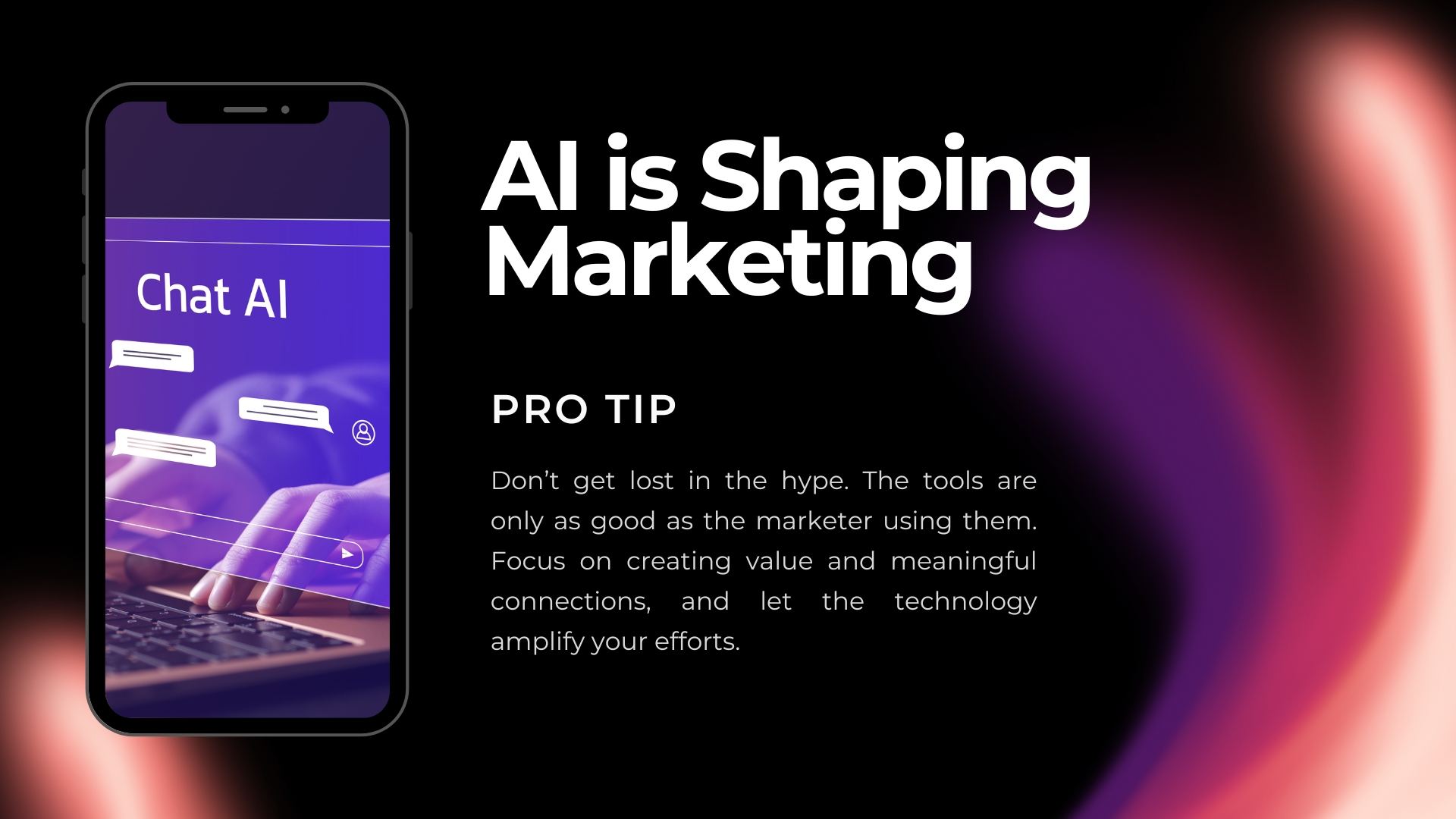
Pro Tip:
Don’t get lost in the hype. The tools are only as good as the marketer using them. Focus on creating value and meaningful connections, and let the technology amplify your efforts.
Here’s what’s changing and how you can stay ahead:
Key Trends in SEO
Content Audits Are Essential
Spammy, outdated, or thin content isn’t just irrelevant—it’s actively hurting your rankings. Google’s algorithm now emphasizes delivering valuable, up-to-date content to users, making content audits a critical first step in any SEO strategy.
Actionable Tip: Conduct a content audit using tools like SEMrush or Ahrefs. Identify pages with outdated information, poor performance, or low-quality backlinks. Update, consolidate, or remove content as needed to improve relevance and user experience.
eCommerce Evolution
Google is refining product listings in search results, prioritizing detailed, user-friendly pages with accurate product information. This shift means that for eCommerce businesses, optimizing product pages for both SEO and user intent is no longer optional—it’s essential.
What to Focus On:
Use structured data markup to enhance product visibility in rich snippets.
Optimize product descriptions for target keywords while emphasizing user benefits.
Include high-quality images, videos, and user reviews to build trust and engagement.
Reputation is Key: E-E-A-T (Expertise, Experience, Authority, Trustworthiness)
Websites that clearly demonstrate experience, expertise, authority, and trustworthiness (E-E-A-T) are seeing the biggest gains. This is particularly important for businesses in YMYL (Your Money or Your Life) categories, like health, finance, and legal services.
How to Build Reputation:
Showcase author credentials on blog posts and articles.
Earn high-quality backlinks from reputable sources.
Ensure your site has robust security (SSL) and an easy-to-navigate design.
What You Should Do Now
Refresh Your Content Regularly Content needs to evolve alongside user intent. Search engines reward pages that stay current and relevant, so schedule periodic updates for your blog posts, product pages, and service offerings. Quick Win: Add recent statistics, fresh examples, or new insights to your top-performing content to keep it competitive.
Map Out the Buyer’s Journey Understanding where your audience is in their decision-making process is critical. Use this knowledge to create content for each stage of the buyer’s journey—awareness, consideration, and decision.
Example:
Awareness: Blog posts and educational guides.
Consideration: Case studies and comparison articles.
Decision: Clear product pages, testimonials, and FAQs.
Optimize for Semantic SEO With Google focusing more on understanding user intent, semantic SEO—targeting related keywords and topics—has become essential. This approach aligns your content with how users naturally search. Tool Tip: Use platforms like AnswerThePublic or SEMrush Topic Research to identify long-tail keywords and related topics for your content strategy.
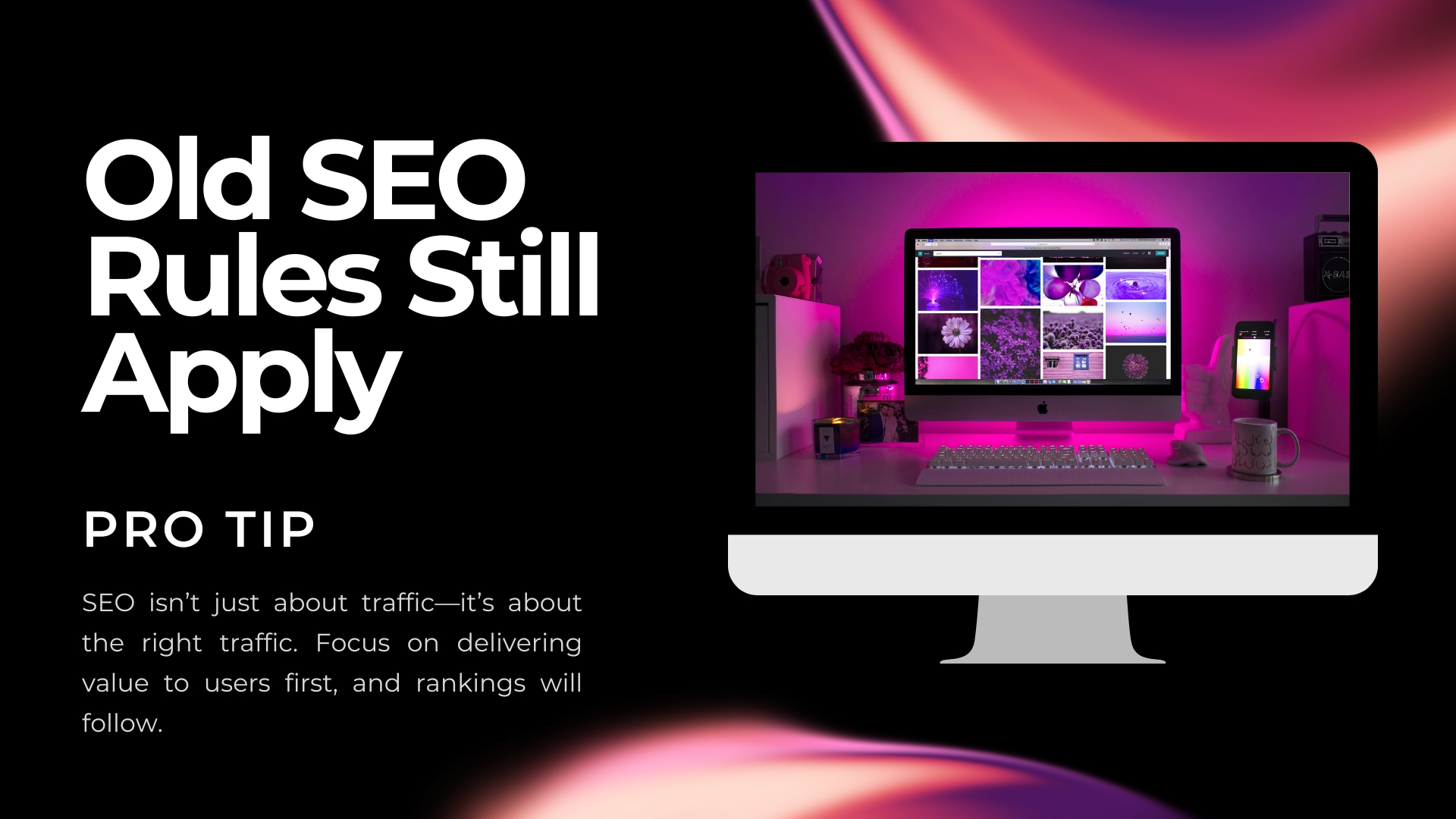
Pro Tip:
SEO isn’t just about traffic—it’s about the right traffic. Focus on delivering value to users first, and rankings will follow.
Marketing Trends to Watch in 2025
Marketing in 2025 is evolving beyond just AI and SEO advancements. Broader trends are reshaping how brands connect with audiences, build trust, and drive engagement. Let’s break down the key trends and how you can incorporate them into your strategy.
1. Social Media Commerce: Transforming How We Shop
Platforms like TikTok, Instagram, and even Pinterest are going all-in on social commerce, turning likes and comments into direct sales. Features like TikTok Shopping, Instagram Checkout, and Pinterest Product Pins are making it easier than ever for users to buy without leaving their favorite apps.
Why This Matters: Social media commerce blends entertainment and convenience, creating seamless experiences that drive impulse purchases. For brands, it means meeting customers where they’re already spending their time.
Use video content to showcase products in action—behind-the-scenes footage, tutorials, or influencer collaborations are great options.
Analyze your audience’s behavior to identify which platforms drive the most conversions.
2. Sustainability Messaging: Aligning with Consumer Values
Consumers care deeply about sustainability. According to a 2023 Nielsen survey, 78% of people say they’re more likely to buy from brands that demonstrate sustainable practices. From eco-friendly packaging to supply chain transparency, brands that lead with sustainability are building long-term loyalty.
Why This Matters: Today’s customers aren’t just buying products—they’re buying into values. Brands that weave sustainability into their messaging and operations will win the hearts (and wallets) of socially conscious consumers.
Action Steps:
Audit your supply chain and highlight sustainable practices in your marketing materials.
Share stories about how your brand is making a difference—whether it’s reducing waste, supporting fair trade, or partnering with environmental nonprofits.
Be transparent. Consumers value honesty, even if your brand isn’t perfect.
Short-form video content like TikTok videos, Instagram Reels, and YouTube Shorts continues to dominate engagement metrics. Why? Because it delivers value fast, in a way that’s highly shareable and digestible.
Why This Matters: Audiences crave quick, engaging content that entertains or informs. The success of short-form content is a testament to our increasingly limited attention spans and the power of creativity in a compact format.
Action Steps:
Experiment with storytelling in 30 seconds or less. For example, create teaser videos, quick how-tos, or fun behind-the-scenes clips.
Use platform-specific trends (like TikTok challenges) to make your brand relatable and relevant.
Don’t forget captions—80% of users watch videos without sound.
4. Data-Driven Personalization: Marketing That Feels Human
While not new, personalization is becoming increasingly sophisticated. AI tools now enable hyper-personalized campaigns that adjust messaging based on real-time user behavior.
Why This Matters: Generic marketing is out. Personalization builds trust and relevance, leading to higher engagement, conversions, and customer loyalty.
Action Steps:
Leverage CRM tools and AI to segment your audience by interests, behavior, and purchase history.
Personalize email campaigns with tailored product recommendations.
Use dynamic website content to display personalized offers or content based on user location or browsing behavior.
5. The Rise of Experiential Marketing in Virtual Spaces
With advancements in AR, VR, and metaverse platforms, brands are creating immersive experiences that drive deep emotional connections.
Why This Matters: Experiential marketing allows customers to interact with your brand in memorable, impactful ways, fostering loyalty and advocacy.
Action Steps:
Experiment with AR filters on social media to showcase products in fun, interactive ways.
Host virtual events or pop-up stores in the metaverse.
Partner with creators to develop immersive branded experiences.
What You Should Do Now
2025 will challenge marketers to think differently, act boldly, and connect authentically. Use these trends as a guide to refresh your strategy and keep your brand relevant in a rapidly changing world.
Preparing for 2025 and Beyond
Marketing in 2025 will test the adaptability and creativity of every brand. The rapid evolution of AI, SEO, and broader industry trends presents an exciting—but challenging—opportunity for marketers. The tools at our disposal are more powerful than ever, but the true differentiator will be how we wield them.
To succeed, you’ll need to look beyond the technology and focus on what really matters: your audience.
Understand Their Needs: Stay curious about your audience’s behaviors, preferences, and pain points. Use data, but don’t forget to apply empathy and intuition to create campaigns that resonate deeply.
Build Authentic Connections: Consumers value honesty, transparency, and brands that align with their values. Whether it’s through personalized content, sustainable messaging, or engaging storytelling, the goal is to create relationships that last.
Adapt and Iterate: The strategies that work today may not work tomorrow. Be willing to experiment, learn from failures, and adjust your approach to stay relevant in a world that never stops evolving.
The Bottom Line?
The future of marketing isn’t just about embracing innovation—it’s about using it to amplify the human side of your brand. Those who balance cutting-edge tools with a customer-first mindset will lead the way into 2025 and beyond.
CEO, Business Consultant, Researcher and Marketing Strategist
Jenny Weatherall is the co-owner and CEO of Eminent SEO, a design and marketing agency founded in 2009. She has worked in the industry since 2005, when she fell in love with digital marketing… and her now husband and partner, Chris. Together they have 6 children and 3 granddaughters.
Jenny has a passion for learning and sharing what she learns. She has researched, written and published hundreds of articles on a wide variety of topics, including: SEO, design, marketing, ethics, business management, sustainability, inclusion, behavioral health, wellness and work-life balance.
In fact, this isn’t the first time I’m addressing the infamous “SEO is dead” mantra. Back in 2012, I wrote a post on our blog titled “Why SEO Is Not Dead.” Even then, amidst chatter about the changing algorithms and supposed end of SEO as we knew it, I argued that SEO was not dying—it was adapting.
Looking back, my predictions stood the test of time. The core principles I highlighted, like focusing on user experience, valuable content, and genuine optimization strategies, are even more relevant now. The same narrative that SEO would vanish with every major technological leap has replayed over the years, and yet here we are.
So, Why Do People Think SEO Is Dead This Time?
Every few years, a new disruptor emerges that sets the digital marketing world on edge. This time, it’s the rapid evolution of AI and automation that’s making people question the future of SEO.
But let’s unpack why this fear has taken hold:
The Rise of AI and Conversational Search
With the arrival of tools like ChatGPT and other AI-powered platforms, users are beginning to get more tailored, conversational answers without having to sift through traditional search results. The introduction of AI summaries and generative responses in search has left many wondering if organic search traffic will dry up as users opt for more instant, chatbot-style answers.
The Threat of Traffic Diversion
There’s growing concern among marketers and publishers that AI chatbots might divert traffic away from search engines. The logic follows that if users find what they need within an AI response box, they may never make it to the organic results, impacting website visits and potentially cutting into the lifeline of search-driven businesses.
Content Saturation and Algorithm Complexity
The sheer volume of content being produced today—much of it enhanced or generated by AI—has made the landscape more competitive. Additionally, Google’s ever-evolving algorithm, now heavily influenced by machine learning and AI, can feel like a black box, making some believe that SEO tactics are becoming obsolete or impossible to master.
Misunderstanding of SEO’s Role
SEO today is more complex than it was when meta keywords were a top-ranking factor. This shift has led to the perception that traditional optimization is no longer relevant. People mistake the evolving practices as evidence that SEO itself is dying, rather than recognizing that it’s adapting to user behavior and new technology.
SEO is (Always) Evolving
Despite the influx of fears and headlines proclaiming the end of SEO with each technological advancement, one truth has stood the test of time: search and SEO have proven to be adaptable and resilient. We’ve seen it before. Whether it was with major algorithm updates like Panda and Penguin, the introduction of voice search, or the rise of mobile-first indexing, SEO has evolved to meet new challenges head-on.
The current wave of anxiety surrounding AI and automation is no different. Yes, these technologies are changing the landscape, reshaping how users interact with search engines and how search engines deliver results. But rather than seeing SEO as on the brink of extinction, it’s more accurate to view it as a discipline that’s simply morphing to incorporate these new tools.
In this post, I’ll explore why SEO isn’t dying but evolving—adapting to shifts in user behavior, integrating new technologies, and enhancing its strategies to remain effective. I’ll show why SEO continues to be a valuable investment for businesses and how it has maintained its relevance through every wave of disruption.
We’ll cover:
The importance of search to Google’s business model and why this ensures the longevity of SEO.
The resilience of SEO in past disruptions and technological advancements.
The current impacts of AI on search and why these changes enhance, rather than replace, SEO.
Why investing in SEO now is smarter than ever, especially as it evolves to meet the needs of a tech-savvy, AI-influenced world.
Let’s dive into how SEO is holding strong and why it will continue to do so.
The Importance of Search to Google’s Business Model
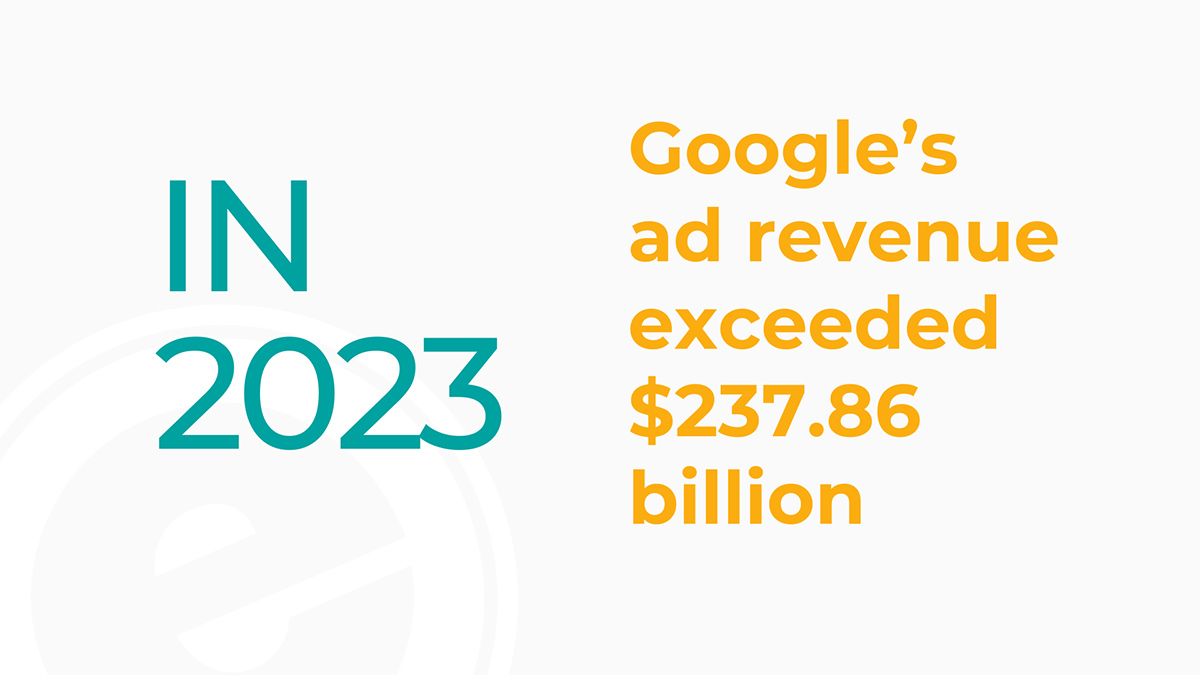
One of the most overlooked points when discussing the potential decline of SEO is Google’s reliance on search as its primary revenue driver. Google’s core business model revolves around search-driven advertising. In 2023, Google’s ad revenue exceeded $237.86 billion, according to Statista. This revenue comes from its Google Ads platform, which allows advertisers to display ads, product listings, and service offerings across a vast network of Google properties, partner sites, and apps.
This heavy reliance on search advertising underscores the fact that search isn’t going anywhere—it’s essential to Google’s profitability and long-term strategy.
Dominance of Organic Search Traffic
Organic search continues to be a primary source of website traffic globally. Studies show that organic search accounts for 57.8% of all web traffic, making it the largest traffic driver by far (Backlinko). This statistic underscores the importance of maintaining robust SEO practices to capture this significant source of traffic.
User Trust and Engagement
Users also tend to trust organic search results more than paid advertisements. In fact, the #1 organic result on Google receives approximately 27.6% of all clicks, proving the immense value of achieving high rankings through effective SEO (Backlinko). This trust factor plays a crucial role in building credibility and driving engagement, as users perceive top organic results as more authoritative and relevant.
Why This Matters for SEO
Google has a vested interest in keeping search relevant and engaging for users. This means that even as new technologies like AI are integrated, search remains central to how Google operates. The company continues to invest in making search better, incorporating features like AI-driven summaries and enhanced user experience to maintain and grow their ad revenue.
SEO’s Role in This Ecosystem
For businesses, this means that SEO will continue to play a critical role. While paid search ads bring in revenue for Google, organic search results drive the majority of traffic for businesses. By optimizing for SEO, companies align themselves with Google’s goal of providing valuable, trustworthy content that satisfies user intent.
This synergy between organic search optimization and Google’s reliance on ad revenue ensures that SEO remains a valuable tool for online visibility.
SEO’s Track Record of Resilience
To further understand why SEO isn’t going anywhere, it’s helpful to look back at how it has weathered past changes and adapted to new challenges. From the early 2000s when keyword stuffing and spammy backlinks were standard practice, to the significant algorithm updates that flipped strategies on their heads, SEO has continually reinvented itself.
Major Algorithm Updates and the Industry’s Response
Consider Google’s Panda update in 2011, which aimed to eliminate low-quality content and rewarded websites with valuable, user-focused information. This change prompted SEO professionals to shift from quantity to quality. Then came the Penguin update in 2012, which targeted manipulative link-building practices. These updates forced the industry to move toward more ethical, long-term strategies.
Each time, skeptics declared that SEO would not survive the shift. But what actually happened was the opposite: the field matured, and the importance of expertise, authority, and trustworthiness (E-A-T) became foundational to good SEO practices.
Mobile-First and Voice Search
The shift to mobile-first indexing in 2018 and the rise of voice search were other turning points. Both changes were met with similar declarations of SEO’s “death.” However, they ended up pushing the industry to become more user-centric, with an emphasis on mobile-friendly design and natural language optimization.
The Integration of AI
Now, with AI-powered tools influencing search engines and user behavior, some see it as the final blow to SEO. But history shows that SEO is not about avoiding change; it’s about embracing it.
AI itself has become a part of SEO strategy—enhancing keyword research, automating reports, and refining content optimization. The adaptability of SEO means it will continue to integrate these tools, making it even more efficient and data-driven.
The Integration of AI and Modern Adaptations in SEO
The integration of AI into search engines and digital tools has brought both excitement and apprehension within the SEO community. The current narrative might suggest that AI will make traditional SEO obsolete, but in reality, it’s fueling its evolution.
Here’s how SEO professionals are adapting to these advancements:
Leveraging AI for Enhanced Keyword Research and Content Strategy
SEO tools powered by AI, such as Clearscope, SurferSEO, and Semrush’s AI features, are transforming the way professionals conduct keyword research and create content strategies. These tools can analyze vast amounts of data in seconds, offering insights into keyword difficulty, user intent, and content gaps. As a result, SEOs can make more informed decisions, target highly specific search intents, and produce content that matches what users are searching for with more precision than ever before.
Automating Routine SEO Tasks
AI has been a game-changer for handling repetitive SEO tasks. From automating site audits to generating meta descriptions, AI tools are streamlining processes that used to take hours. This efficiency allows SEO professionals to focus on higher-level strategy, creativity, and user-focused optimizations that require human insight.
Adapting to AI-Driven Search Features
With Google’s advancements, like the Multitask Unified Model (MUM) and generative AI-powered features in Search Generative Experience (SGE), search results are becoming more sophisticated and nuanced. These AI integrations provide detailed, context-rich answers directly on the results page, sometimes reducing the need for users to click through to websites. However, this shift emphasizes the importance of position zero (featured snippets) and adapting content to be more comprehensive and structured to capture those spots.
The Role of AI in Personalization and User Experience
AI’s influence extends beyond traditional keyword optimization to creating personalized user experiences. SEOs now consider how to enhance site structure, content quality, and engagement metrics to align with user-focused AI algorithms. This means optimizing for E-A-T, crafting authoritative and informative content, and ensuring that websites meet user expectations in terms of speed, design, and mobile-friendliness.
Embracing AI-Generated Content with Caution
While some businesses use AI to generate content at scale, successful SEO professionals know that AI-generated content should be carefully curated and edited for quality. Search engines value original, high-quality content, and human oversight is essential for maintaining authenticity and aligning with brand voice.
Real-World Example
Brands like HubSpot and Moz are already using AI tools to enhance their SEO efforts, demonstrating that combining AI insights with human expertise is the way forward. HubSpot, for instance, integrates AI to personalize user experiences and optimize their extensive content library, ensuring their content stays relevant and ranks well.
SEO’s Resilience Amid Change
The key takeaway is that SEO has always adapted to technological shifts.
AI is not replacing SEO; it’s becoming a powerful tool that enhances it. Professionals who use AI to bolster their strategies and focus on long-term, user-centric goals are better positioned than ever to thrive.
SEO is evolving into a smarter, more adaptable discipline, integrating data-driven tools and personalized user experiences while maintaining its fundamental focus on quality and user engagement.
How AI is Revolutionizing SEO Tools and Processes
Expanding Capabilities with AI-Powered SEO Tools
SEO platforms are continuously evolving to harness the power of AI, delivering smarter tools that elevate the way SEO professionals work. Tools like SurferSEO and Clearscope use natural language processing (NLP) to analyze top-performing pages and guide content optimization by recommending keywords, headings, and semantic phrases that align with user intent. ChatGPT and other AI writing assistants can draft outlines, generate topic ideas, and offer creative suggestions that save time during the content creation process.
Example of AI Implementation
Semrush’s AI Writing Assistant helps refine content by analyzing tone, readability, and SEO-friendliness, creating a balance between human touch and algorithmic precision. This integration allows marketers to produce content that not only ranks well but is tailored to user expectations and engagement.
Expert Opinion on AI and SEO
Industry experts emphasize that AI’s role is not to replace SEO professionals but to amplify their capabilities. Rand Fishkin, co-founder of SparkToro, noted that “AI in SEO will be a game-changer for those who use it to augment creativity, perform better analysis, and free up time for strategic thinking.” This perspective aligns with the reality that while AI can handle data-heavy, repetitive tasks, the human element of strategy, empathy, and complex decision-making remains irreplaceable.
AI-Driven Search Features and SERP Evolution
Google’s Search Generative Experience (SGE) has shifted how users interact with search results, integrating AI-driven summaries that provide rich, multi-layered answers directly in the SERP. While this feature may seem like a threat to traditional click-through rates (CTRs), it presents an opportunity for SEOs to adapt content strategies. Optimizing for structured data, concise and comprehensive answers, and authoritative E-A-T content is now more crucial than ever to appear in these AI-rich results.
The AI-Human Balance
Lily Ray, SEO Director at Path Interactive, has highlighted that “The future of SEO will involve finding the right balance between automated processes and human creativity. AI can help identify trends and streamline work, but SEO is fundamentally about connecting with humans, which requires intuition and personal touch.”
Integrating AI for Personalized User Experiences
Beyond search engines, AI is influencing how websites cater to user behavior. SEO professionals now focus on enhancing user experiences through personalized content recommendations, chatbots, and AI-driven site search functionality. This shift ensures that users are not only finding websites but are also engaged once they arrive, improving metrics that search engines value, like dwell time and bounce rate.
Preparing for the Next Phase of SEO
SEO isn’t about chasing trends; it’s about understanding the underlying principles that make content valuable and relevant. AI adds another layer to this, providing data and tools that empower SEO professionals to adapt quickly. Successful SEOs are those who use AI to refine strategies, predict shifts in search behavior, and focus on high-value content creation that resonates with their target audience.
Key Takeaway: The integration of AI into SEO is not the end but an evolution. By leveraging AI tools for efficiency and pairing them with human insight for strategy and creativity, SEO professionals can continue to drive results. The future of SEO lies in adaptability, innovation, and a commitment to staying ahead of technological changes without losing sight of what makes SEO powerful: delivering value to users.
Why SEO is Still a Valuable Investment
For businesses wondering whether SEO is still worth the investment, especially with AI changing the landscape, the answer is a resounding yes.
Here’s why:
SEO Drives Sustainable, Long-Term Results
SEO isn’t about quick wins—it’s a long-term investment that builds a foundation for sustained visibility. Unlike paid advertising, which stops working as soon as the budget runs out, SEO provides ongoing benefits as your content and website grow in authority. Investing in SEO ensures that your business remains discoverable in organic search, even as trends shift.
Organic Search is a Primary Traffic Driver
Data consistently shows that organic search accounts for more than half of all website traffic. While AI chatbots and voice search may supplement user queries, the vast majority of people still turn to search engines for comprehensive information. SEO helps your business stay visible where it matters most—on search engine results pages (SERPs) where your potential customers are actively looking.
SEO and AI Are Complementary, Not Conflicting
AI is not here to replace SEO but to enhance it. The smartest SEO strategies now incorporate AI tools for deeper analysis, improved content quality, and efficient research. This synergy between SEO and AI allows businesses to stay ahead of competitors by leveraging data-driven insights and producing content that resonates with audiences.
Adaptability to Technological Advancements
SEO has thrived through every major shift—algorithm updates, mobile-first indexing, and the integration of voice search. The current wave of AI is just the next chapter. SEO professionals use AI to automate repetitive tasks and gain deeper insights, allowing them to focus on creative and strategic elements that AI alone can’t deliver. This adaptability proves that SEO is more resilient and innovative than ever.
Enhancing User Experience and Engagement
Google’s algorithms are heavily influenced by user behavior, such as how long visitors stay on a page and how they interact with content. SEO optimizes websites for these factors, creating a seamless, engaging user experience. AI tools can provide recommendations for improving site performance, but SEO is essential for applying these improvements in a meaningful way that aligns with brand goals.
Strengthening Brand Credibility and Trust
Ranking high in organic search results signals credibility to users. When people see your business at the top of the results, they inherently trust it more. This trust is invaluable and can’t be achieved by paid advertising alone. SEO builds this trust through consistent optimization, content quality, and authoritative backlinks.
The Bottom Line: SEO Remains a Smart Investment
SEO’s value lies in its ability to adapt and integrate new technologies like AI while maintaining its focus on user-centric strategies. Businesses that continue to invest in SEO are investing in long-term growth, visibility, and customer trust. The smartest approach is to use AI as a tool that enhances SEO efforts, not as a replacement.
In today’s digital age, the combination of strategic SEO and AI-driven insights offers an unparalleled opportunity to engage audiences and maintain a strong online presence. SEO is not just surviving; it’s thriving by evolving and embracing the very technologies that some believe are making it obsolete.
CEO, Business Consultant, Researcher and Marketing Strategist
Jenny Weatherall is the co-owner and CEO of Eminent SEO, a design and marketing agency founded in 2009. She has worked in the industry since 2005, when she fell in love with digital marketing… and her now husband and partner, Chris. Together they have 6 children and 3 granddaughters.
Jenny has a passion for learning and sharing what she learns. She has researched, written and published hundreds of articles on a wide variety of topics, including: SEO, design, marketing, ethics, business management, sustainability, inclusion, behavioral health, wellness and work-life balance.
As we close out the year, I’m excited to share our latest blog post that tackles a topic we’ve all heard countless times: “SEO Is Dead.” Spoiler alert-it isn’t. In fact, SEO is more relevant than ever, evolving alongside technological advancements like AI to remain a cornerstone of digital marketing.
In this insightful post, we explore why SEO continues to thrive despite ongoing discussions about AI and automation.
Here’s what we cover:
Debunking the “SEO Is Dead” Myth: We explain why this misconception keeps resurfacing and the truth behind it.
Google’s Dependence on Search: With $237.86 billion in ad revenue in 2023 (Statista), Google’s business model heavily relies on search, ensuring that SEO remains essential.
SEO’s Proven Adaptability: From major algorithm updates to mobile-first indexing, SEO has consistently adapted and strengthened with each new challenge.
AI’s Role in Enhancing SEO: Rather than replacing SEO, AI tools are enhancing its effectiveness-streamlining keyword research, content optimization, and data analysis to improve strategies.
If you’re looking for insights into why investing in SEO is one of the best long-term moves for your business, this post is a must-read.
Good to Know in SEO:
November 2024 Core Update
In addition, don’t forget that Google recently rolled out its November 2024 core update. This update may have impacted your site’s performance, so it’s essential to keep an eye on your rankings and adjust your strategy accordingly. For more details, refer to Google’s core update documentation.
What’s Next for SEO in 2025:
As we look forward to 2025, our focus at Eminent SEO will remain on leveraging AI, adapting to new technologies, and ensuring our clients stay at the forefront of digital marketing. Stay tuned for more insights, updates, and strategies to keep your business thriving.
Thank you for being a valued part of our community. Your trust and partnership mean the world to us, and we’re excited to continue growing together.
Warmly, Jenny Weatherall
New on the Blog:
Elevate Your Marketing Strategy
We’ve also added a new blog post to help guide your marketing efforts:
Good SEO Starts with Your Content Strategy
Create an SEO content strategy with actionable steps, keyword tips, content gap analysis, and advanced optimization. Boost your site’s authority and engagement.
Meta, the parent company of Facebook, officially introduced Threads, its rival to Twitter, last Wednesday, following the announcement of the app just three months earlier.
Threads has had an impressive start, attracting 100 million sign-ups within its first week, according to the app. The platform has already gained traction among numerous brands, celebrities, journalists, and other high-profile users.
Bluesky, a decentralized social platform envisioned by former Twitter CEO Jack Dorsey, was developed alongside Twitter. It features a user interface similar to Twitter, offering algorithmic customization, a federated structure, and moderation tailored to specific communities. By November 2024, Bluesky had exceeded 20 million users. Its rapid growth was driven in part by controversial policy shifts at X, including the removal of the block feature and permitting third-party companies to use users’ posts to train AI, propelling the app to the top of the U.S. App Store charts.
Eminent SEO provides strategic SEO campaigns with measurable results along with expert website design, development, pay per click, content and social media and organic website marketing. 800.871.4130.









 High Quality Website Design and Development



 Despite the influx of fears and headlines proclaiming the end of SEO with each technological advancement, one truth has stood the test of time: search and SEO have proven to be adaptable and resilient. We’ve seen it before. Whether it was with major algorithm updates like Panda and Penguin, the introduction of voice search, or the rise of mobile-first indexing, SEO has evolved to meet new challenges head-on.